
Coast Guard jobs include enlisted military specialties, commissioned-officer careers, part-time Reserve positions, federal civilian employment, and jobs with the Coast Guard Exchange and related community services programs.
Those are different hiring and career systems. A boat crew member, an aviation mechanic, a marine inspector, a federal IT specialist, and an Exchange store manager can all support the Coast Guard without having the same entry requirements, training, pay, or service obligations.
If you are deciding where to apply, I would start with the type of work you want and the employment system you are willing to enter—not a list of impressive job titles. Then check whether you qualify, whether the opportunity is available, what your paperwork actually promises, and where you may be assigned.
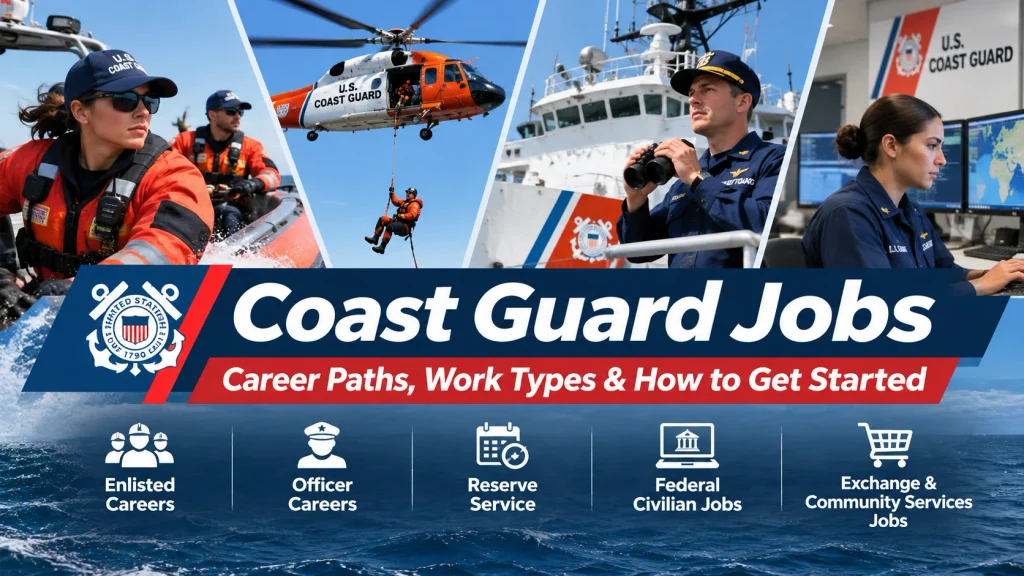
What kinds of Coast Guard jobs are available?
| Career pathway | Work and entry route | Pay and key consideration |
|---|---|---|
| Active-duty enlisted | Full-time uniformed service. Qualify for an occupational rating such as boatswain’s mate, machinery technician, or operations specialist; receive military and rating training. | Military pay grade and service time govern basic pay. A preferred rating and the eventual unit assignment are different decisions. |
| Commissioned officer | Leadership and professional career tracks covering operations, aviation, engineering, response, prevention, and support. Enter through an applicable commissioning program. | Officer military pay grades. Selection for a commissioning program does not promise every specialty or assignment. |
| Coast Guard Reserve | Military service alongside civilian life, in enlisted or officer roles, including operational and support units. Entry and local billet requirements matter. | Reserve military pay depends on duty performed and grade. Training, activation, and deployment commitments vary. |
| Federal civilian | Apply for specific federal jobs in engineering, administration, IT, maritime safety, healthcare, and other fields through civilian hiring. | Position-specific federal pay, often with grade and locality factors. No military enlistment or enlisted boot camp. |
| Exchange and community services | Apply for civilian jobs in Coast Guard Exchange retail, recreation, childcare, hospitality, and support operations. | Position-specific non-appropriated fund (NAF) employment terms, not military basic pay or automatically the federal General Schedule. |
The first decision is whether you want to serve in uniform. If so, choose between an enlisted specialty, an officer path, and active or Reserve service.
If you want a particular civilian occupation without military obligations, search federal civilian vacancies. If retail, recreation, or childcare is your goal, search Coast Guard Community Services Command careers separately. The official Coast Guard careers hub distinguishes the major military and civilian pathways.
One distinction applies across the uniformed options: your occupational specialty is not your duty station. A rating tells you the work you are trained to perform; the unit and billet help determine your actual duties, schedule, travel, and operational tempo.
Also Read: Coast Guard vs Navy
How Coast Guard missions translate into jobs
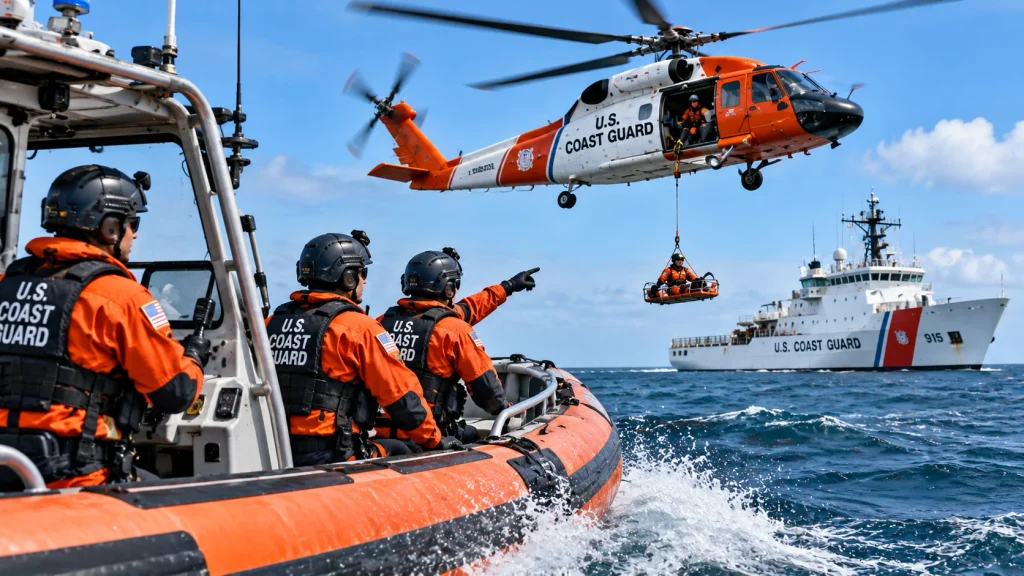
The Coast Guard carries out search and rescue, maritime law enforcement, vessel safety and security, environmental protection, navigation support, and national-defense-related duties.
These missions need visible operational crews and less-visible technical, medical, logistics, and administrative personnel.
A distress call, for example, can involve an operations specialist coordinating communications, a boat crew responding from a station, an aviation crew conducting a search, and technicians maintaining the equipment. That example illustrates how distinct specialties contribute; it is not a fixed staffing rule for every case.
For a separate explanation of the mission rather than careers, see what the Coast Guard does.
Enlisted Coast Guard jobs: what the ratings actually do
Enlisted occupational specialties are called ratings. A prospective recruit may initially enter as a non-rate before attending rating-specific Class A school, although some accession arrangements include specialty training terms. The official enlisted careers directory is the best starting point for current rating descriptions; the examples below are a practical selection, not a claim to list every rating or every possible duty.
| Rating or field | What the work involves | Assignment question to ask |
|---|---|---|
| Boatswain’s Mate (BM) | Boat handling, seamanship, navigation, crew leadership, and potentially maritime boardings after qualification. | Will the billet involve a small-boat station, cutter, or another operational unit? |
| Machinery Technician (MK) | Diagnosing and repairing engines and other mechanical systems that keep boats, cutters, and equipment operating. | What machinery and watchstanding duties are associated with the unit? |
| Aviation Survival Technician (AST) | Rescue-swimmer work, survival equipment, and demanding aviation rescue preparation. | Can you meet the current medical, swimming, physical, and training-selection standards? |
| Aviation Maintenance Technician (AMT) / Aviation Electrical Technician (AET) | Maintaining aircraft mechanical systems or aircraft electrical and avionics systems; qualified personnel can also perform aircrew duties. | Which aircraft, air station, and aircrew qualification opportunities apply? |
| Maritime Enforcement Specialist (ME) | Maritime law-enforcement and security expertise, including training and tactical or boarding-related responsibilities. | Does the opening involve general law-enforcement support or a specialized security unit? |
| Marine Science Technician (MST) | Commercial vessel and waterfront facility inspections, pollution response, and marine environmental protection. | Is the work primarily prevention, inspections, or incident response? |
| Operations Specialist (OS) | Monitoring operations, handling distress communications, coordinating response information, and maintaining the operational picture. | Will the role be in a shore command center, aboard a cutter, or another command-and-control environment? |
| Health Services Technician (HS) | Clinical support, patient care, medical readiness, and certain administrative or diagnostic tasks within the scope of training. | Will the billet support a clinic, a cutter, or another medical service setting? |
| Cyber Mission Specialist (CMS) | Cybersecurity missions, digital systems defense, and specialized technical work. | Which current cyber aptitude and screening requirements apply to entry or training? |
| Electronics, information technology, and logistics | Electronics Technicians (ETs) maintain technical systems; Information Systems Technicians (ITs) support communications and networks; Storekeepers (SKs) manage supplies and purchasing; Yeomen (YNs) handle personnel administration. | Is the billet operational support, technical maintenance, or an administrative organization? |
Compare the substance of the jobs. BM and ME can both be involved in law enforcement, but BM centers on seamanship and boat operations, while ME is a law-enforcement specialty.
MK and MST may both work around vessels, but MK maintains mechanical systems and MST deals with safety, inspections, and environmental protection. The setting may overlap while the qualifications and daily responsibilities differ.
Likewise, AST and AMT are both connected to aviation, but rescue-swimmer training and aircraft maintenance are different disciplines.
If you want to repair equipment, look closely at MK, AMT, AET, ET, or IT. If you want to coordinate missions rather than physically board vessels, examine OS. If you prefer public-facing inspections and environmental work, compare MST against the prevention officer track.
Other ratings support the service through damage control, food service, finance, and human resources. Those are not secondary in importance simply because they are less visible in recruiting videos. Review each official rating profile for training, required qualifications, and possible work environments before deciding.
Coast Guard officer jobs are a different career system
Officers are not assigned an enlisted rating in the way enlisted personnel are. Officer careers are organized around specialties and professional tracks, with a greater emphasis on leading people and operations, managing programs, and applying professional expertise. The Coast Guard identifies officer fields including afloat, aviation, engineering and command, control, communications, computers, cyber and intelligence (C5I), healthcare, prevention, response, and support.
- Afloat and response: Lead cutter operations, maritime response, and operational teams. An officer’s eventual duties depend on qualification and assignment.
- Aviation: Compete for an applicable aviation pathway and flight training. Being selected to commission is not itself a promise of a pilot position. See the site’s deeper guide to becoming a Coast Guard pilot.
- Engineering and C5I: Manage engineering, information systems, cyber, and technical programs or operational capabilities.
- Prevention: Work in commercial-vessel safety, inspections, maritime regulatory compliance, and related oversight.
- Healthcare and support: Serve in specific medical, logistics, finance, legal, or personnel-related roles, subject to the relevant commissioning or professional requirements.
Entry is program-specific. The Coast Guard Academy, Officer Candidate School, and eligible direct-commission routes do not share one application or selection process. Review the official officer application paths and confirm which credentials, testing, service history, and professional licenses a specific program requires.
Coast Guard medical jobs: three different possibilities
“Medical jobs” does not identify one entry route. The enlisted Health Services Technician rating supports clinical services and medical readiness.
Licensed medical professionals may be eligible for professional officer or direct-employment routes, and Coast Guard healthcare also operates through a partnership with the U.S. Public Health Service Commissioned Corps. Separately, civilian federal healthcare vacancies use civilian hiring rules.
The Coast Guard’s healthcare career guidance distinguishes physicians, physician assistants, dentists, mental-health professionals, and other positions.
If your objective is to practice a licensed profession, do not assume HS is interchangeable with a physician, nursing, or other clinical commissioning route. Check license requirements, accession authority, and the exact employer for the opening.
Coast Guard Reserve jobs and service commitments
Reserve positions can include many of the same enlisted ratings and officer specialties as active-duty service, but their available billets, training programs, geographic requirements, and duty commitments are not identical.
Coast Guard recruiting states that a prospective Reserve applicant needs an assignment matching their location and specialty; entry arrangements differ for students, applicants with existing technical skills, and prior-service members. See the enlisted accession guidance for the current Reserve program descriptions.
Many Reservists train about one weekend a month and two weeks a year, but that is not a universal limit on service or a guarantee against activation.
For example, the Coast Guard states that Port Security Units typically train one weekend a month and four weeks a year, and can deploy for extended periods during activations. Ask about the exact unit, travel to drill, training pipeline, and mobilization obligations before accepting a billet.
Civilian Coast Guard jobs and Exchange employment
Federal civilian positions
Federal civilian Coast Guard jobs can involve marine safety, engineering, acquisition, finance, administration, cybersecurity, IT, emergency management, and healthcare.
These employees work for the Coast Guard but are not enlisted or commissioned by taking a civilian job. Hiring depends on the qualifications, grade, location, eligibility category, and closing date in the actual vacancy announcement.
Use the Coast Guard civilian vacancy search on USAJOBS to filter openings. Read the complete announcement—including who may apply, required specialized experience, work schedule, pay, relocation, and any security clearance—rather than assuming a job family is currently hiring in your preferred city.
Coast Guard Exchange and community services positions
The Coast Guard Community Services Command oversees non-appropriated fund (NAF) employment for Coast Guard Exchanges (CGX), recreation programs, and child development services.
Openings can include store clerks, managers, warehouse staff, recreation aides, hospitality workers, childcare assistants, IT, and marketing staff. These are civilian jobs; military affiliation is not generally required to apply.
Apply through the official Exchange and Community Services Command careers page. Do not assume a CGX position follows the military pay table or that its pay and benefits automatically match a General Schedule federal job; read the individual vacancy’s terms.
ASVAB scores and other qualifications for Coast Guard jobs
For enlisted applicants, two different questions are frequently confused: Do you qualify to enlist? and Do your ASVAB scores and other credentials qualify you for a particular rating?
As listed in the Coast Guard’s current recruiting instructions, the minimum Armed Forces Qualification Test (AFQT) score for enlistment is 32. That is a general enlistment threshold, not proof that an applicant qualifies for AST, CMS, ME, MST, or any other rating.
Specific ratings may depend on ASVAB composite or line scores, medical or physical standards, aptitude, security eligibility, schooling, and available training seats.
I would not use a third-party chart of occupational ASVAB cutoffs as a binding 2026 qualification table. Instead, take the scores from your official test record to a Coast Guard recruiter and ask them to check the current requirements for each rating you are considering.
Confirm whether a retest, waiver, or prerequisite is actually authorized in your case. Officer commissioning programs and federal civilian positions use their own selection criteria; the enlisted AFQT minimum should not be applied to them.
Can you choose your job in the Coast Guard?
You can express a preference and may qualify for specific career options, but preference alone does not guarantee a rating, school date, unit, or location.
The Coast Guard says active-duty recruiters assess eligibility for incentives that can include guaranteed specialty training in applicable cases. Whether such an option is available to you, and exactly what it guarantees, must be established before you sign.
- Preference: Identify the ratings or officer fields you actually want, plus acceptable alternatives.
- Qualification: Establish your current test, physical, medical, education, background, and program eligibility.
- Availability: Ask which eligible options have current training access, recruiting incentives, or Reserve billets. A qualifying score alone does not create an opening.
- Selection: Understand whether you are being accepted into military service, selected for a commissioning program, or placed on a specific training path.
- Written commitment: Ask which specialty training, school, bonus, service term, and other terms are explicitly recorded in the enlistment or accession paperwork. A verbal preference is not a written guarantee.
- Assignment: Separately ask how your first unit and later duty stations will be assigned. A specialty or training commitment is not necessarily a guaranteed station.
There is an important 2026 policy affecting enlisted members already in the service. Under ALCOAST 106/26, issued April 27, 2026, effective June 1, 2026, eligible non-rates who have been at their unit for 12 months without selecting an A-school may be placed on an A-school waitlist based on ASVAB scores and the Coast Guard’s needs.
The message also describes an exception process for certain members with less than 24 months left on their contract who do not intend to continue serving.
It does not say every applicant is assigned a random job or that every new recruit receives a guaranteed choice. It does mean that postponing a rating decision indefinitely may not remain an option under the policy.
If the career you want is unavailable, ask what the alternatives mean in writing: joining now in another status, qualifying for a different rating, waiting to apply, or using a distinct accession path.
Do not accept a promise that an exact career field will “work itself out” unless the applicable terms support it.
Training and unit assignments change the work

Enlisted training generally begins with Coast Guard basic training at Training Center Cape May, followed by the training and qualification sequence required for the member’s status and rating.
The timing of Class A school varies by accession agreement, eligibility, and availability. For the initial training experience, see the site’s Coast Guard boot camp guide.
Officers follow their relevant commissioning and specialty training paths; civilian employees do not attend military recruit training as a condition of ordinary civilian employment.
A BM on a cutter and a BM at a small-boat station have the same underlying rating but can face different operating patterns.
An OS coordinating activity at a shore command center does not have an identical workplace to an OS on a cutter. The following unit types are functional settings, not promises that each rating has billets at every one.
| Assignment setting | Typical work environment | What varies |
|---|---|---|
| Cutter / afloat unit | Shipboard operations, watchstanding, maintenance, and missions underway. | Time away, cutter type, mission, and operational schedule. |
| Small-boat station | Boat crews responding to local missions and maintaining readiness. | Duty rotations, local conditions, and qualifications. |
| Air station | Aircraft operations, aviation maintenance, aircrew training, and response missions. | Aircraft type, qualifications, and flight operations. |
| Sector / shore command center | Operational coordination, marine safety, prevention, inspections, and response oversight. | Watch duties versus daytime inspection or staff work. |
| Base / support / headquarters | Logistics, purchasing, technical support, administration, planning, and training. | Specialty, management function, and local workload. |
| Specialized unit | Specialized security, response, or other narrowly defined operational missions. | Selection, extra training, readiness, and deployment obligations. |
Official descriptions of operations specialists, marine science technicians, and Port Security Units establish why workplace and mission differences matter. You can also use the site’s Coast Guard air station guide to explore aviation locations, but a list of stations is not a job-vacancy or assignment guarantee.
Before treating any position as a predictable “shore job” or “travel job,” ask about the actual billet, watch schedule, qualifications, underway or deployment expectations, and how future reassignment works. Those questions are more useful than a generic promise about work-life balance.
Coast Guard jobs and pay: compare the right systems
Military basic pay follows pay grade and creditable service, not the enlisted rating’s name. Two enlisted members at the same grade and service time generally share the applicable basic-pay rate even if one repairs aircraft and the other operates boats.
Actual compensation can differ because of authorized housing or subsistence allowances, special or incentive pay, duty location, entitlements, and eligibility for recruiting bonuses.
For a concrete comparison, the following figures come from the DFAS 2026 enlisted and 2026 officer basic-pay tables, effective January 1, 2026. Each assumes two or fewer years of creditable service, shows a monthly active-duty basic-pay rate only, and excludes allowances, special pay, deductions, taxes, and any bonus. Officer prior-enlisted-service exceptions and other table notes still apply.
| 2026 pay grade | Monthly basic pay | What it demonstrates |
|---|---|---|
| E-3 | $2,836.80 | An enlisted rate independent of whether the member works in navigation, maintenance, or support. |
| E-4 | $3,142.20 | A higher enlisted grade; not a salary automatically attached to a particular rating. |
| O-1 | $4,150.20 | A commissioned-officer rate, not a promise of any specific officer assignment. |
Reserve pay is a separate calculation: drilling status, duty periods, grade, years of service, and active-duty periods affect compensation. Do not multiply an active-duty monthly example into a Reserve salary without checking the applicable DFAS Reserve and drill-pay guidance.
Federal civilian pay follows the position’s announced pay system, grade or pay band, location, and other applicable rules. The Office of Personnel Management’s 2026 pay tables help interpret General Schedule offers, but not every civilian job uses the same system.
Exchange and other NAF jobs follow the compensation and benefits specified by their employer and posting. Comparing a store associate’s hourly wage to an officer’s military basic pay without considering hours and the different benefit systems would be misleading.
How to find the Coast Guard job that fits your qualifications
Instead of asking which Coast Guard job is universally “best,” narrow the choice with the variables you can verify:
- Choose an employment system. Decide among full-time enlistment, an officer application, Reserve service, federal civilian hiring, and Exchange/NAF work.
- Choose the actual tasks. Separate boat operations, aviation rescue, mechanical repair, cyber, marine inspections, clinical care, administration, and leadership. Write down two or three specific roles.
- Check the entry requirements. For enlisted roles, verify official ASVAB qualification and any additional screening. For professional officer or civilian positions, check degrees, licenses, experience, clearances, and application instructions.
- Check the unit and service commitment. Identify whether cutter time, rotating watches, mobilization, specialized training, relocation, or particular duty stations would make a role unsuitable.
- Check availability and written terms. Ask a recruiter what is currently open or use the live vacancy announcement. Confirm any guaranteed school, incentive, grade, location, and service term in the applicable written paperwork.
- Compare compensation correctly. Use current DFAS tables for military pay, the specific USAJOBS announcement for federal civilian pay, or the Exchange employer’s posting for NAF pay.
For military entry requirements and next steps, continue with how to join the Coast Guard and the official recruiting process. For civilian opportunities, start with current Coast Guard vacancies. The next sound decision is not simply choosing a job title; it is identifying an eligible, available pathway whose work and obligations you understand well enough to accept.

Jeffrey Rogers has served in the United States Army for 18 years. Jeffrey served on overseas combat tours in Afghanistan and Iraq. Jeffrey Rogers was born in Norfolk, Virginia. He graduated in Information technology from George Mason University. Now, Jeffrey is the content head of Frommilitarybases.com.