
The main difference between the Coast Guard and Navy is the mission you join to support. The Coast Guard concentrates on maritime safety, law enforcement, search and rescue, and security, while the Navy is organized primarily for sea control, naval warfare, and projecting military power around the world.
Both are U.S. military services. Both have ships, aircraft, shore assignments, and jobs that can take you far from home. If you’re choosing where to enlist, your actual career field and assignment matter more than either branch’s reputation.
| What to compare | Coast Guard | Navy |
|---|---|---|
| Core mission | Maritime rescue, law enforcement, safety, environmental protection, security, and defense support. | Sea control, deterrence, combat readiness, global naval operations, and support to other forces. |
| Typical platforms | Cutters, small boats, aircraft, and shore-based units. | Surface warships, submarines, aircraft, and shore-based units. |
| Career emphasis | Maritime enforcement, rescue, marine safety, engineering, aviation, technology, and support specialties. | Ship and submarine operations, aviation, nuclear propulsion, warfare, intelligence, engineering, technology, and support specialties. |
| Enlisted boot camp | Eight weeks at Training Center Cape May, New Jersey. | Nine weeks at Recruit Training Command, Great Lakes, Illinois. |
| Deployments | Can range from days to months; depends on cutter, unit, and mission, including overseas operations. | Many ship deployments run for months; shore and other assignments have different patterns. |
| Basic pay | Federal military pay tables based on grade and creditable service. | The same federal basic-pay tables for the same grade and creditable service. |
| Ways to serve | Active duty and Coast Guard Reserve; enlisted and officer paths. | Active duty and Navy Reserve; enlisted and officer paths. |
How to read the table: Start with the work you want to perform, then ask where that job can be assigned and how often those units leave home. Don’t read “Coast Guard” as “always home” or “Navy” as “always at sea.” The shorter Coast Guard boot camp does not establish which branch is easier to join or serve in.
Before committing, have each recruiter explain your eligibility, available training path, active-duty term, remaining service obligation, and which promises appear in writing. The mission and training entries above come from the Coast Guard’s mission overview, Navy training command, and each service’s recruiting information.
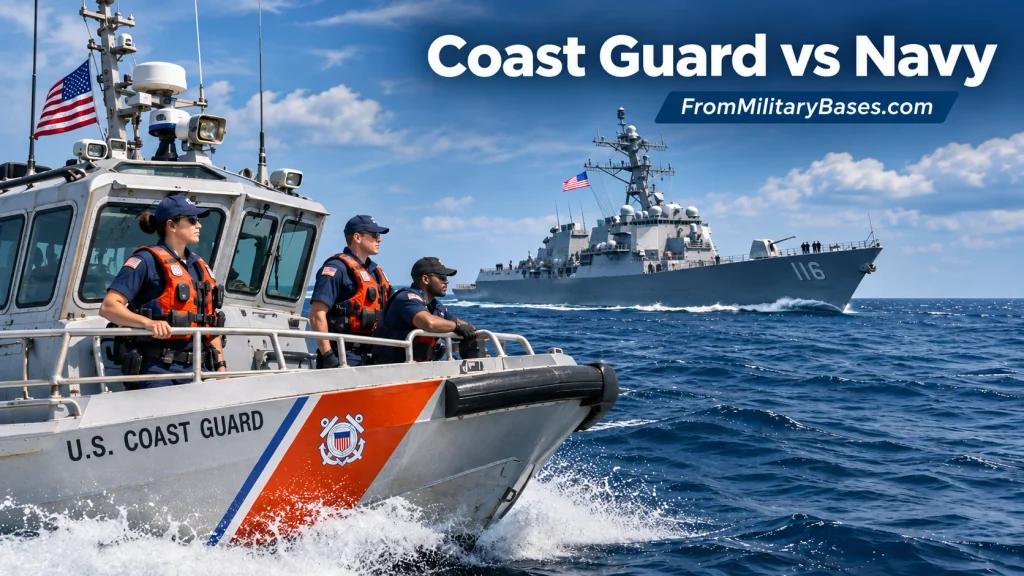
The Coast Guard has statutory responsibility for missions such as maritime search and rescue, vessel and port safety, drug interdiction, aids to navigation, fisheries enforcement, and marine environmental protection. Its law-enforcement authorities make those duties central to the service.
It also conducts defense operations and works alongside the Navy and other military forces. The Coast Guard’s official mission list explains the scope; my separate guide to what the Coast Guard does goes deeper into the day-to-day missions.
The Navy’s central purpose is to organize, train, and equip forces for naval operations, including protecting sea routes, deterring threats, operating warships and submarines, and supporting military operations around the world.
This is a difference in primary responsibility, not a rule that one branch saves people while the other never does. The Navy also has first-responder careers, and Coast Guard personnel can perform defense and security missions.
If rescue swimming or aviation appeals to you, investigate the actual qualification path in each service rather than assuming the work exists in only one.
Yes, the Coast Guard is a military branch. No, it isn’t normally part of the Navy. 14 U.S.C. § 101 makes it an armed force at all times. It ordinarily operates within the Department of Homeland Security.
Under 14 U.S.C. § 103, it can operate as a service in the Navy when the president directs or when Congress directs that result in a declaration of war. A declaration of war alone is not a blanket rule that every Coast Guard unit automatically becomes Navy.
Compare the job, not just the uniform
Both services offer enlisted occupations and commissioned-officer careers, but similar job titles do not always mean similar work. For an enlisted applicant, I would choose two or three specific specialties to investigate before making a branch decision.
- Rescue and aviation: The Coast Guard lists aviation survival technician (AST), aviation maintenance technician, and avionics electrical technician among its enlisted specialties. The Navy offers aviation and rescue-related positions too. The selection, training, and eventual flying assignment are separate questions.
- Law enforcement and maritime security: Coast Guard maritime enforcement specialists work in a service with broad maritime law-enforcement responsibilities. A Navy security-related job is not interchangeable with Coast Guard law enforcement; compare the authorized duties and likely units.
- Engineering, cyber, and communications: Both services maintain engines, electrical equipment, electronics, and networks. Look at the actual equipment, qualifications, assignment options, and civilian credentials rather than assuming the same rating name means the same career.
- Warships, submarines, and nuclear propulsion: If your specific goal is a submarine or nuclear-propulsion career, the Navy’s career catalog is the relevant starting point. If you want marine safety inspections or environmental response, start with the Coast Guard enlisted catalog.
The Coast Guard’s basic-training guidance describes initial assignments as unspecialized seamen or firemen followed by advanced specialty training.
Some applicants may have different training arrangements or incentives, so don’t assume an advertised specialty is already locked in. Compare each service’s written rules for job selection, school seats, waiting periods, qualification standards, and reassignment if you cannot complete training. Coast Guard enlisting guidance explicitly directs applicants to discuss specialty-training and bonus eligibility with recruiters.
Thinking about becoming an officer? Compare officer accession programs separately. The Coast Guard’s officer application routes and the Navy’s officer routes involve different programs, qualifications, selection boards, and service commitments.
Completing the minimum application requirements does not guarantee selection, a particular specialty, or an assignment. Likewise, promotion rates and opportunities change by field, staffing, and year; branch size alone doesn’t predict your advancement.
For active-duty enlisted applicants, USAGov’s requirements page, updated July 15, 2026, lists an enlistment age range of 17–41 for both the Coast Guard and Navy. That is an initial screening range, not a promise of eligibility.
Citizenship or qualifying residency, education, the ASVAB, medical screening, fitness standards, security requirements, and the chosen job can affect your options. Officer programs and Reserve components have their own requirements; discuss any waiver directly with the service.
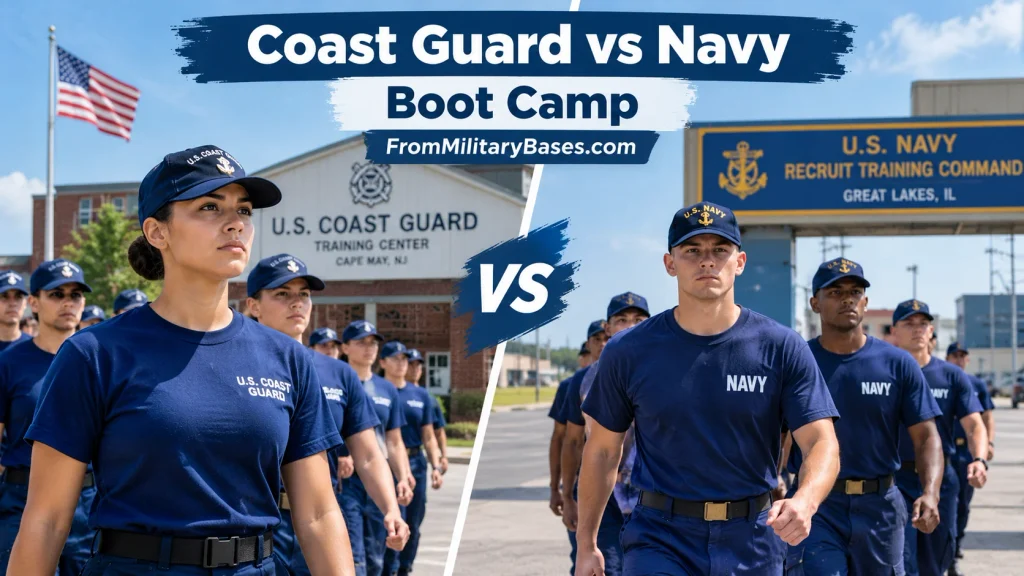
For enlisted recruits, Coast Guard boot camp lasts eight weeks at Cape May; Navy boot camp currently lasts nine weeks at Great Lakes. Those are the durations published by the Coast Guard and Navy’s training authority.
Both teach military discipline, basic seamanship, physical readiness, and emergency-response skills. Specialized job training may continue well after graduation. Neither the one-week difference nor online “hardest boot camp” claims tell you how difficult your specialty’s training will be.
For preparation and an explanation of the Coast Guard’s training process, see the site’s Coast Guard boot camp guide; use the service’s current official page for up-to-date entry rules and schedules.
Deployments, duty stations, and quality of life
This is where a simple “Coast Guard versus Navy” verdict becomes least reliable. A Coast Guard member at a shore station, a cutter crew member, a Navy sailor aboard a deployed destroyer, and a Navy member in a shore-based technical job do not have the same schedule.
Coast Guard cutters can operate overseas, and Navy personnel do not all spend their careers on ships. For example, a July 2026 Coast Guard announcement describes expeditionary cutter operations in the Western Pacific, not a purely domestic service.
Military OneSource’s deployment guidance gives useful context: many Navy ship or submarine deployments last around six or seven months, with exceptions; Navy assignments away from a ship can follow very different timelines.
Coast Guard time away can range from days to several months, depending on the unit and mission. These are illustrations of different operating patterns, not promised limits or a deployment forecast for your first assignment.
Training, maintenance, duty watches, and unexpected operations can also affect time at home outside a formal deployment.
Housing, family time, and personal autonomy depend on the location, duty schedule, available housing, and your circumstances.
A short patrol is not the same as predictable evenings at home; a shore billet is not automatically a nine-to-five job.
If family routine is a deciding factor, compare likely units in your desired specialty and ask about watch rotations, field exercises, duty sections, travel, family housing, and how often those assignments change. I would not choose a branch on an anonymous quality-of-life score alone.
Neither branch automatically pays more in basic pay. Federal military basic-pay rates are organized by pay grade and years of creditable service, not by whether you wear a Coast Guard or Navy uniform.
The Defense Finance and Accounting Service’s 2026 pay tables list active-duty basic pay and separate Reserve drill-pay rates.
What lands in your account can still differ because total compensation is more than basic pay. Depending on eligibility, it can include housing and food allowances, special or incentive pays, and bonuses, as well as noncash benefits.
Duty location, dependents, job qualifications, orders, and program rules can change what applies. An advertised enlistment bonus is neither universal nor equivalent to a higher monthly base-pay rate.
Compare offers for the same pay grade and service status, then request a written breakdown of the actual bonus conditions, payment timing, eligibility, and any repayment provisions. Start with the current Coast Guard pay and benefits and Navy pay and benefits information.
Career value works the same way: a technical rating can develop civilian-relevant skills, but military training does not automatically confer every civilian license, certification, or hiring qualification. Ask what credentials you can actually earn, what prerequisites you must meet, and whether support for those credentials is available for your specialty.
Active duty, Reserve service, and what you really commit to
Active duty is full-time military service. Reserve service is generally structured around part-time training but includes the possibility of activation, mobilization, and time away. The Coast Guard describes its Reserve as a force that trains locally and can deploy globally.
The Navy describes a typical drilling schedule of one weekend per month plus two weeks of annual training, while noting that actual Reserve roles and obligations vary; see Navy Reserve information. Both have enlisted and officer Reserve opportunities, with availability tied to your qualifications and an appropriate position.
Do not confuse the active-duty period advertised to you with your total military service obligation. Under 10 U.S.C. § 651, the ordinary initial obligation is set by applicable regulations within a six-to-eight-year statutory range, with remaining service potentially completed in a Reserve component.
Certain officer programs, specialties, bonuses, or training agreements may create additional obligations. Your recruiter should identify the active-duty term, drilling Reserve obligations if any, inactive Reserve obligations if any, and every related agreement in your individual paperwork. Don’t infer your contract from somebody else’s online example.
Six questions to take to both recruiters
Use the same questions with each service. The aim is to compare two real offers rather than two recruiting slogans.
- Which exact enlisted rating or officer program am I eligible to pursue? What tests, medical standards, citizenship requirements, selection boards, and job-specific screening apply?
- What is actually guaranteed in writing? Does the agreement name a job or school, or only an opportunity to compete? What happens if a school is unavailable or I don’t qualify?
- Where could this specialty be assigned? Which cutters, ships, squadrons, stations, or shore units use it? What can and cannot be guaranteed about my first assignment?
- What would time away look like in those units? Ask about typical underway periods, on-call duty, watch schedules, deployments, overseas assignments, and the limits of any estimate.
- What am I signing up for? Separate the active-duty period, total service obligation, Reserve or inactive-Reserve responsibilities, and any extra schooling or bonus commitment.
- What is the verified financial and career offer? Ask for basic pay by grade, applicable allowances and special pays, bonus terms, schooling, civilian credentials, and how advancement is decided in that specialty.
Request the current official program documents and read the final written agreement before signing. A recruiter can explain a likely outcome; a conversation alone does not create a job, duty-station, deployment, or promotion guarantee.
Lean toward the Coast Guard if you want your career centered on maritime rescue, law enforcement, environmental response, marine safety, or the Coast Guard’s particular mix of small-boat, cutter, aviation, and shore missions.
Lean toward the Navy if your specific goal is naval combat systems, submarines, nuclear propulsion, aircraft-carrier operations, or another Navy specialty not offered by the Coast Guard. Both can lead to demanding operational assignments, technical training, and meaningful service.
When both branches offer work you would enjoy, compare the specific specialty, training entry point, likely assignment types, time-away pattern, and written commitment.
The best choice is the offer that matches the work you want and the obligations you’re prepared to accept—not a claim that one entire branch is easier, safer, better paid, or better for family life. For a Coast Guard-only perspective, you can also read the site’s Coast Guard pros and cons guide.

Jeffrey Rogers has served in the United States Army for 18 years. Jeffrey served on overseas combat tours in Afghanistan and Iraq. Jeffrey Rogers was born in Norfolk, Virginia. He graduated in Information technology from George Mason University. Now, Jeffrey is the content head of Frommilitarybases.com.
1 thought on “Coast Guard vs Navy: Jobs, Pay, Deployments & Requirements”