
During war, the U.S. Coast Guard protects ports and shipping, intercepts vessels, supports Navy and joint military operations, and can participate in combat. It also continues to carry out civilian maritime safety, rescue, and law enforcement duties as required.
One important distinction is that the Coast Guard does not automatically become part of the Navy when the United States goes to war. Federal law establishes specific conditions for that transfer.
Individual Coast Guard units can support military commanders even when the service remains within the Department of Homeland Security (DHS).
If you are considering a Coast Guard career, this means you could serve overseas in a military operation, support the war effort from the United States, or continue working in an ordinary Coast Guard assignment. Your orders, unit and qualifications determine your responsibilities.
What are the Coast Guard’s wartime missions?
The Coast Guard’s responsibility for national defense is not limited to wartime. Under 14 U.S.C. § 102, defense readiness is one of its statutory missions. The service maintains capabilities that can support the armed forces before, during and after an armed conflict.
The official Defense Operations Program identifies eight areas of defense work, covering maritime interception, environmental response, port defense, international security cooperation, control of coastal waters, helicopter interception of aircraft, counterterrorism and coordination of responses to maritime threats.
The following table translates those capabilities and related wartime support duties into practical responsibilities. It is not a list of additional statutory missions.
| Responsibility | Purpose and capability |
|---|---|
| Port and infrastructure security | Protect shipping, terminals and military cargo movements using port security units and other maritime security forces. |
| Maritime interception | Help identify and intercept vessels under applicable authority; cutters and law enforcement detachments can support joint operations. |
| Coastal sea control and naval support | Help maintain access to coastal waters and support military shipping; cutters and specialized personnel may be assigned to naval forces. |
| Navigation and maritime transport | Maintain or restore navigation aids, support access to ports, and provide icebreaking capabilities where needed. |
| Military environmental response | Prepare for and respond to spills and hazardous incidents that threaten personnel, waterways or military operations. |
| International defense cooperation | Work with partner maritime services through training and other authorized security cooperation activities. |
| Air interception and maritime threat response | Provide specialized aviation and maritime security capabilities to support authorized defense and counterterrorism missions. |
| Search and rescue | Use aircraft, boats, cutters and rescue specialists to assist people in distress, including during military conflicts. |
For an example of how these activities fit together, the Coast Guard’s history of Operation Iraqi Freedom describes escort work, port protection, vessel interception and navigation support.
A buoy tender’s work restoring navigation aids helped shipping reach Iraqi ports. Those duties were important to the military campaign even though restoring a buoy is not itself combat.
Defense readiness also does not account for all Coast Guard support to the military. A 2021 Government Accountability Office review found that the Coast Guard supported the Department of Defense through missions outside the defense-readiness classification, including ice operations and coastal security.
Its analysis covered fiscal years 2011–2020, not the likely distribution of duties in a future war.
For the service’s full range of responsibilities, see what the Coast Guard does in its everyday missions.
Not automatically. The Coast Guard is a military service regardless of the federal department in which it operates. Its status is established by 14 U.S.C. § 101; its departmental placement is governed by 14 U.S.C. § 103.
Section 103 provides for two ways the Coast Guard can be directed to operate as a service in the Navy:
- Congress expressly directs the transfer in a declaration of war.
- The President directs the transfer, whether or not Congress has formally declared war.
When such a transfer occurs, the Coast Guard comes under the Secretary of the Navy’s orders. It remains in that arrangement until the President issues an executive order returning it to DHS. The end of hostilities alone does not automatically return it.
Congress added the express-direction condition to the declaration-of-war provision in 2006. This is why descriptions based on older versions of the law can be misleading.
There is a separate command arrangement that does not require a service-wide transfer. Coast Guard personnel and units can be placed under the operational control of military commanders for particular missions. Their service identity does not change simply because they support a Navy or joint force.
The Defense Operations Program expressly provides for work under Coast Guard control or a Department of Defense combatant commander.
A combatant command directs assigned military forces across service boundaries; it is not the same thing as the Department of the Navy administering the entire Coast Guard.
World War II provides an example of service-wide Navy control. Vietnam and Iraq provide examples of Coast Guard participation in armed conflicts without that same service-wide arrangement.
The Maritime Law Enforcement Academy’s historical explanation distinguishes the two models.
Military operations and armed conflicts do not necessarily involve a formal congressional declaration of war.
Neither an undeclared conflict nor a declaration by itself establishes that the entire Coast Guard has transferred. For the underlying distinction between military status and departmental placement, see whether the Coast Guard is military under federal law.
Does the Coast Guard fight in wars and see combat?
Yes. Coast Guard personnel have taken part in direct combat, including antisubmarine warfare during World War II and maritime combat missions during Vietnam. The service has also performed security and combat-support assignments in Iraq.
However, serving during a war and participating directly in combat are different things. I would separate Coast Guard wartime assignments into four broad categories:
- Combat: Military operations involving direct engagement with hostile forces.
- Defense and force protection: Protecting military shipping, personnel and facilities against threats.
- Combat support: Providing navigation, transport inspections, communications, maintenance and other services needed by military forces.
- Continuing civil missions: Rescuing people, enforcing maritime law and keeping domestic ports safe.
These are explanatory categories, not official personnel classifications. The same unit can undertake different kinds of work on different assignments.
If you join, your potential exposure to combat will depend on the conflict, your unit, mission, qualifications and orders.
A shore assignment does not guarantee immunity from danger, and an overseas deployment does not necessarily involve fighting. No service-wide percentage can tell you what your personal risk will be in a future war.
For details about assignments away from home, patrols and overseas duty, read how Coast Guard deployments work.
Which Coast Guard units support wartime operations?
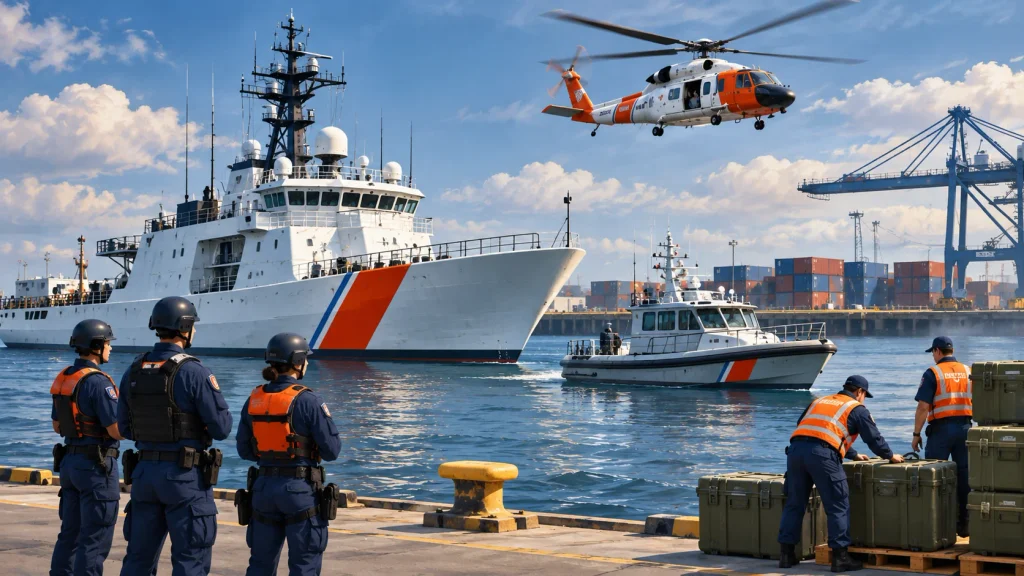
The Coast Guard provides military commanders with different types of expertise. A cutter crew, a port security unit and an environmental response specialist do not perform interchangeable jobs.
| Unit or capability | Potential defense contribution |
|---|---|
| Cutters | Patrols, escort, maritime interception, rescue, navigation support or icebreaking, depending on vessel and mission. |
| Port Security Units (PSUs) | Expeditionary security for ports, vessels and critical infrastructure; important opportunities for Reserve personnel. |
| Tactical Law Enforcement Teams (TACLETs) and Law Enforcement Detachments (LEDETs) | TACLETs provide specialized law enforcement capabilities; their deployable LEDETs may embark on military vessels for authorized maritime operations. |
| Maritime Security Response Teams (MSRTs) | Specialized response to high-risk maritime threats, including terrorism. |
| Maritime Safety and Security Teams (MSSTs) | Mobile security support for ports, waterways and coastal areas. |
| Regional Dive Lockers and National Strike Force | Underwater technical work, infrastructure and vessel support, or specialized hazardous-material and environmental response. |
| Aviation and mission-support personnel | Aircraft operations, rescue, maintenance, engineering, logistics and other functions that sustain the force. |
The Coast Guard’s Special Missions Command announcement describes the roles of its deployable specialized forces (DSF), including PSUs, TACLETs, MSRTs, MSSTs, Regional Dive Lockers and the National Strike Force.
In May 2026 the service announced plans to consolidate these forces under a Special Missions Command, with initial operational capability targeted for October 2026.
That announcement establishes the planned organization, not proof that every phase has been completed. A LEDET is a deployable detachment, not another name for the entire TACLET.
These specialized Coast Guard capabilities should not be confused with the military special operations forces organized under U.S. Special Operations Command. Nor is every DSF assignment a combat assignment.
See the Coast Guard specialized forces guide for the distinctions between units and career paths.
What happens to ordinary Coast Guard missions during war?
War does not eliminate the need for maritime law enforcement, search and rescue, navigation aids, port inspections or pollution response. These responsibilities remain part of the service’s statutory mission set, although commanders may change how resources are allocated in response to wartime needs.
For example, during the Korean War, Coast Guard cutters provided weather observations, communications and rescue coverage that helped both military and commercial traffic cross the Pacific. The Coast Guard’s ocean-station history explains how those familiar service capabilities contributed to military logistics.
In World War II, rescue work continued in American coastal waters as well as overseas. In the Iraq War, the Coast Guard also protected military cargo loading and domestic ports, as documented in the Historian’s Office account of the post-9/11 defense effort. A wartime deployment abroad and a domestic assignment protecting a port can contribute to the same national defense effort.
What wars has the Coast Guard participated in?
The modern Coast Guard was established in 1915 when the Revenue Cutter Service and the U.S. Life-Saving Service merged. Its maritime military heritage extends further back, but it is important to distinguish its predecessors from the service that exists today.
Here are selected conflicts documented by the Coast Guard Historian’s Office. The periods describe the conflicts or relevant U.S. operations, not the dates of every individual Coast Guard assignment.
| Conflict and period | Documented contribution |
|---|---|
| Quasi-War with France (1798–1800) and War of 1812 (1812–1815) | Predecessor revenue cutters served in these early conflicts; service origins. |
| World War I (1914–1918; U.S. entry 1917) | Convoy protection and naval support; Coast Guard combat history. |
| World War II (1939–1945; U.S. entry 1941) | Convoy escorts, antisubmarine operations, amphibious support, rescue and port security; Coast Guard historical account. |
| Korean War (1950–1953) | Ocean stations, navigation, rescue and port security; National Archives. |
| Vietnam War (Coast Guard deployment began 1965) | Coastal interdiction, combat, port security and navigation; official Vietnam collection. |
| Persian Gulf War (1990–1991) | Boarding teams and mobilized Reserve port security personnel supported Desert Shield and Desert Storm; Reserve history. |
| Iraq War (2003–2011) | Maritime interception, port protection, escort and logistics; Iraqi Freedom history. |
| Afghanistan War (2001–2021) | Specialist cargo inspection and redeployment support ashore; Army account of RAID. |
Other documented operations include Grenada in 1983 and Panama in 1989. The historical record does not mean the Coast Guard fought in the same capacity as the Army or Navy in every conflict.
What did the Coast Guard do during World War II?
During World War II, the Coast Guard operated under the Navy and carried out assignments in both the Atlantic and Pacific theaters.
Its cutters escorted convoys and fought enemy submarines. Coast Guard crews also operated Navy vessels used in amphibious landings, including landing ships and landing craft.
In the Mediterranean, Coast Guard personnel supported Allied landings in North Africa and Italy. In Europe, they participated in the Normandy invasion. Search and rescue remained important throughout the conflict, alongside domestic port protection and other security duties.
The service expanded its workforce substantially. Temporary Reserve personnel helped release regular and military Reserve members for sea duty and other assignments. This historical staffing arrangement should not be confused with today’s civilian Auxiliary or ordinary Reserve drilling requirements.
Read the Coast Guard’s account of its World War II operations and mobilization and the National Archives guide to Coast Guard naval records for further historical context.
What did the Coast Guard do during the Vietnam War?
In 1965, the Coast Guard began supporting Operation Market Time, the naval effort to disrupt the movement of supplies to opposing forces by sea. Coast Guard Squadron One operated patrol boats, and Squadron Three, established in 1967, provided larger cutters for maritime operations and naval gunfire support.
The service also carried out port security, supervised hazardous military cargo loading, maintained navigation aids, operated long-range navigation stations and performed rescue work. These duties illustrate the combination of combat and technical support that distinguished its Vietnam service.
The Historian’s Office Vietnam collection provides photographs, historical accounts and records of these assignments.
Coast Guard involvement in Iraq and Afghanistan
During Operation Iraqi Freedom, Coast Guard cutters, boarding detachments, port security units and support personnel worked with other military forces. They protected shipping and maritime facilities, conducted vessel interception and helped restore navigational access for military and humanitarian transport.
The Coast Guard’s history of the conflict documents the death of Petty Officer Third Class Nathan Bruckenthal in April 2004 during a maritime security operation. His service demonstrates that Coast Guard assignments in a combat theater can involve genuine exposure to hostile action.
Afghanistan illustrates a different kind of assignment. Coast Guard personnel in the Redeployment Assistance and Inspection Detachment (RAID) worked with Army transportation organizations to inspect shipping containers and hazardous cargo being moved out of the theater.
The Coast Guard Historian’s Office documents the team’s work at Bagram Airfield in Afghanistan; the Army’s 2013 account also describes earlier support in Iraq. The assignment was ashore, despite the Coast Guard’s usual maritime focus.
These are historical examples, not predictions about present or future deployment locations. They show why the Coast Guard’s military contribution cannot be measured only by the number of ships it sends overseas.
Does the Coast Guard Reserve deploy during war?
Yes. The Coast Guard Reserve is a military reserve component designed to provide extra trained personnel when operational requirements exceed regular staffing. Its official mission statement covers homeland security, expeditionary defense and domestic emergencies.
Normal inactive-duty training, commonly called drills, is not the same as active-duty mobilization. Reservists can volunteer for active-duty orders, and eligible members can be activated without their consent under applicable statutory authorities. 10 U.S.C. § 12301 includes mobilization provisions for war and other specified circumstances; different authorities have different conditions.
Port Security Units are a notable example of Reserve participation in overseas operations. The Coast Guard Reserve’s historical account documents mobilization for Desert Shield and Desert Storm. Reservists can also fill domestic security, response and mission-support requirements.
Reserve membership is not a guarantee of remaining at home. If you are choosing a Reserve assignment, ask about the specific unit’s mission, readiness requirements, mobilization obligations and the distinction between drilling and active-duty orders.
The official Reserve mobilization resources explain the available support and authorities. See also Coast Guard Reserve pay and benefits.
What does the Coast Guard Auxiliary do during war?
The Coast Guard Auxiliary is a civilian volunteer organization, not a military reserve component. 14 U.S.C. § 3901 establishes its nonmilitary status. Under 33 CFR § 5.20, Auxiliary members cannot engage in direct military missions or direct law enforcement.
Subject to authorization, qualifications and Coast Guard direction, volunteers may help with nonmilitary tasks such as boating safety education, communications, administrative support or other approved activities.
Such support can help the service meet its wider responsibilities, but it does not turn Auxiliary volunteers into combat personnel or give them general police powers.
For the distinction between volunteer support, military service and mobilization, read the guide to Coast Guard Auxiliary missions and limitations.
The services complement one another, but their primary responsibilities differ.
| Coast Guard | Navy |
|---|---|
| Normally administered by DHS; can operate in the Navy under § 103. | A service within the Department of the Navy. |
| Maritime security, law enforcement, safety and defense readiness. | Naval warfare, sea control, deterrence and projection of military power. |
| Routine domestic maritime rescue, regulatory and environmental duties. | Primarily organized for naval military operations, including support to joint forces. |
| Can provide specialized forces and maritime authorities to joint commanders. | Provides fleet capabilities and naval forces to joint commanders. |
The distinction is not that the Navy fights and the Coast Guard never fights. The Navy’s own explanation of its warfighting responsibilities emphasizes control of the maritime domain and power projection.
Coast Guard defense capabilities address overlapping and complementary needs, particularly maritime security and specialized support. For a broader career comparison, see Coast Guard versus Navy.
What would happen to Coast Guard members if war broke out?
There is no single outcome for every member. An active-duty member might remain at a domestic station, receive new orders, deploy with a cutter or specialized unit, or support a joint military command.
A reservist might continue training until activated or receive orders to augment a domestic or overseas mission.
Congress or the President could direct a service-wide Navy transfer under § 103, but that decision would be separate from individual deployment orders. A transfer would not mean every member was sent to a combat zone.
If you are evaluating military service, I would ask a recruiter which assignments your prospective rating or officer specialty can lead to, what qualifications are needed, and what service obligations will appear in your contract. A preference for rescue, engineering or law enforcement does not exempt a military member from lawful wartime orders.
The Coast Guard is an armed service with substantial responsibilities outside combat. Its ability to defend maritime infrastructure, support naval operations and maintain safety at home is precisely why it can contribute to a war in more than one way.

Jeffrey Rogers has served in the United States Army for 18 years. Jeffrey served on overseas combat tours in Afghanistan and Iraq. Jeffrey Rogers was born in Norfolk, Virginia. He graduated in Information technology from George Mason University. Now, Jeffrey is the content head of Frommilitarybases.com.