
No, the Coast Guard Auxiliary is not a joke. It is the official civilian volunteer component of the United States Coast Guard. Its members help prevent boating accidents, teach safety courses, examine recreational vessels and support Coast Guard operations when properly qualified and authorized.
But joining the Auxiliary is not joining the military. Auxiliarists do not receive military basic pay, hold military rank through their membership or gain the authority to arrest people. Their contributions are real, but their responsibilities are different from those of active-duty Coast Guard members and reservists.
I would judge the Auxiliary by the work its volunteers perform, not by how closely their uniforms resemble military uniforms. If you’re considering joining, the more useful question is whether its missions, costs and training requirements match what you want to accomplish.
What is the Coast Guard Auxiliary?
The U.S. Coast Guard Auxiliary (USCGAUX) is a uniformed, nonmilitary organization under the administration of the Coast Guard Commandant. Its legal status and purpose are established in 14 U.S.C. § 3901 and § 3902. It helps the Coast Guard carry out authorized duties rather than operating as an independent maritime police force.
Congress established the original volunteer Coast Guard Reserve on June 23, 1939. In 1941, the civilian organization became the Auxiliary, separate from the military Reserve. The Coast Guard’s June 2026 anniversary message describes its evolution from a recreational boating safety organization into a source of specialist and operational support.
Today, the Auxiliary works alongside active-duty personnel, reservists and federal civilian employees. Those four groups contribute to the Coast Guard in different capacities.
The Auxiliary’s principal public-facing mission remains recreational boating safety, but volunteers can also help meet other authorized Coast Guard needs.
For the distinction between the service itself and its civilian component, see why the Coast Guard is a military branch.
Why do some people think the Coast Guard Auxiliary is a joke?
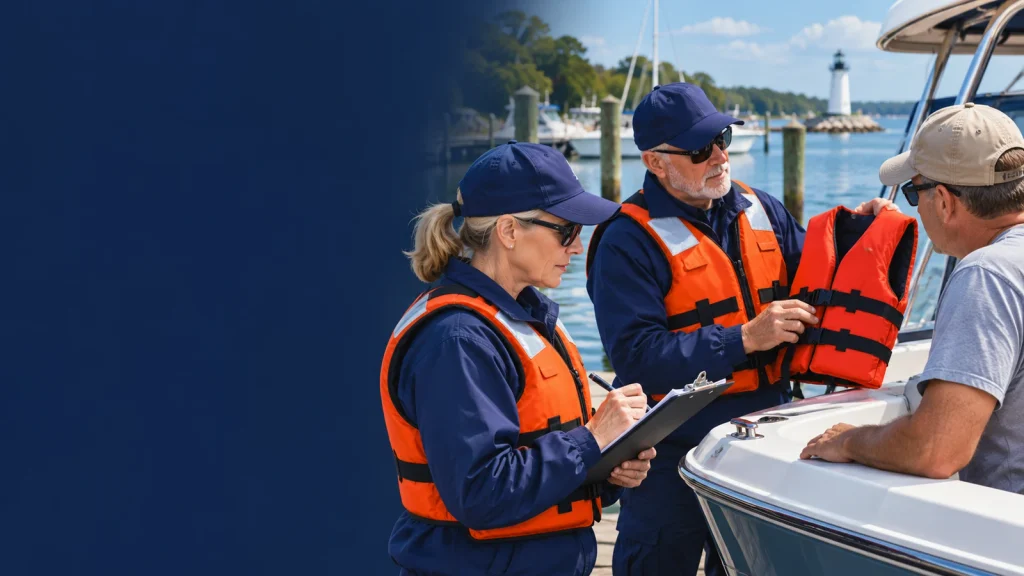
Some of the skepticism comes from the unusual combination of a military-style uniform and civilian volunteer status. In a 2024 discussion about wearing the uniform, prospective and existing members described feeling uncomfortable about being mistaken for military personnel. Others explained that they found the work worthwhile precisely because they could contribute without enlisting.
A 2025 discussion about improving the Auxiliary raised concerns about excessive meetings, inactive membership, appearance standards and the relationship between local volunteers and active-duty units.
Some participants also praised the organization’s work and the opportunities it had given them.
These are individual accounts, not a survey of the organization or official Coast Guard opinion. They do, however, illustrate a useful distinction:
- Military-style insignia can cause confusion, but Auxiliary offices are legitimate organizational responsibilities rather than military ranks.
- Volunteer entry standards differ from military accession standards. That does not eliminate the need to qualify for specific duties.
- A flotilla that offers few missions may not suit an applicant who wants regular operational work. That is a reason to investigate local opportunities, not evidence that the entire organization is ineffective.
The absence of pay and military powers is a real limitation if you’re seeking a military career. It isn’t a defect in an organization established to provide volunteer support.
What does the Coast Guard Auxiliary do?
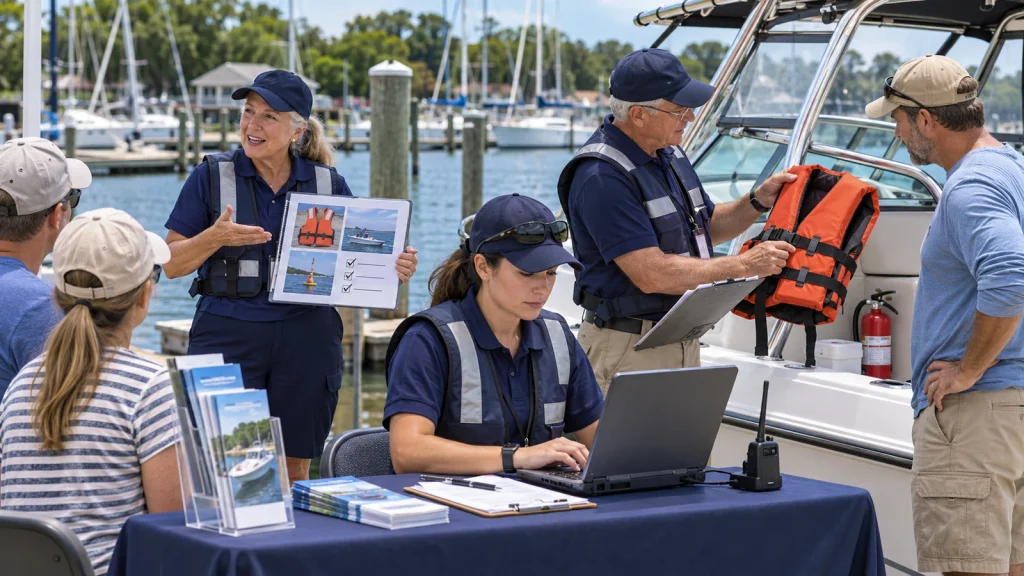
The Auxiliary offers much more than boat rides or meetings. Its official mission directory covers boating education, operations, aviation, marine safety, navigation, communications and other support functions.
What you can do depends on the assignment, your qualifications and the needs of the Coast Guard.
| Mission area | Examples of volunteer work |
|---|---|
| Boating education | Teach approved courses on safe navigation, emergency procedures and boating rules after instructor qualification. |
| Vessel safety checks | Check recreational boats for safety equipment with the owner’s cooperation; explain deficiencies without issuing citations. |
| Surface operations | Qualified crews conduct ordered safety patrols and assist with search and rescue. |
| Marine safety | Support pollution reporting, prevention outreach and authorized inspection or examination activities. |
| Navigation | Help verify aids to navigation and report discrepancies. |
| Communications | Qualified volunteers support radio operations and watchstanding. |
| Aviation (AUXAIR) | Certified pilots, observers and aircrew support searches, observation and logistics using approved facilities under orders. |
| Emergency response | Help with authorized disaster support, planning, logistics or damage assessment. |
| Administrative and specialist support | Assist with records, public affairs, recruiting, IT, interpretation, food service, healthcare or religious ministry when appropriately qualified. |
These are examples of available programs, not duties assigned automatically to everyone who joins. Under 33 CFR §§ 5.22–5.26, assignments require appropriate competence and authorization. Some specialist work also requires professional credentials.
Does the Auxiliary actually help save lives?
Yes. Qualified Auxiliary crews can assist with search and rescue under Coast Guard direction. Preventive work matters too: a vessel safety check can identify missing safety equipment before a boat leaves the dock, and a boating course can teach someone how to respond when an emergency occurs.
The June 2026 Coast Guard anniversary message also identifies volunteers supporting cutter kitchens, standing quarterdeck watches and helping assess hurricane damage using geospatial information.
Those are documented examples of the work the service uses Auxiliarists to perform, not promises that a new member will receive the same assignments.
For the wider context, see the Coast Guard’s main roles and missions.
What can the Coast Guard Auxiliary not do?
The Auxiliary is not an armed enforcement service. 33 CFR § 5.20 prohibits Auxiliary members from carrying out direct law enforcement or military missions.
An Auxiliarist may be assigned to a specific duty and have the authority necessary to execute that duty, subject to regulatory exceptions and limits imposed by the Commandant. That is not a general grant of Coast Guard military or police powers.
Can Auxiliarists board boats or arrest people?
Auxiliary vessel examiners may conduct voluntary recreational vessel safety checks. Qualified members can also provide support to authorized Coast Guard inspection or boarding activities, including providing a boat as a platform for a boarding team.
They do not thereby acquire the power to conduct coercive law enforcement boardings, issue citations or make arrests as Coast Guard enforcement officers.
For example, volunteers assigned to patrol a restricted navigation area may explain the rules to boaters, but § 5.20 expressly prohibits them from enforcing those restrictions.
A member who separately holds a law enforcement position derives any police powers from that position, not Auxiliary membership.
Does the Coast Guard Auxiliary carry weapons?
Normally, no. Chapter 2, section B.21.e of the Coast Guard Auxiliary Manual (COMDTINST M16790.1G) prohibits weapons handling or carriage during Auxiliary activities and Coast Guard operational assignments.
It describes limited waivers requested through Coast Guard channels, including certain wildlife-protection or qualified range-coaching assignments. Such a waiver is not ordinary permission to carry a weapon or perform law enforcement.
If your goal is armed maritime law enforcement or tactical military operations, explore military careers instead. The Coast Guard’s Deployable Specialized Forces are distinct from the Auxiliary.
Coast Guard Auxiliary vs. Coast Guard Reserve vs. active duty
All three support Coast Guard missions, but only the Reserve and active-duty components are military service.
The following comparison describes the usual pathways, not every specialized accession program or duty status. See official Coast Guard recruiting for military entry and benefit requirements.
| Feature | Auxiliary | Reserve | Active duty |
|---|---|---|---|
| Status | Civilian volunteer | Military | Military |
| Service | Voluntary | Usually part-time; may activate | Full-time |
| Pay | No basic pay; eligible expenses only | Paid drills and qualifying orders | Military basic pay and applicable allowances |
| Training | Member and duty qualifications | Military entry and specialty training | Military entry and specialty training |
| Duties | Authorized nonmilitary support | Assigned military or civil missions | Assigned military or civil missions |
| Commitment | Volunteer availability and qualification upkeep | Military service obligation | Military service obligation |
| Deployment | Authorized volunteer temporary assignments | May mobilize or deploy | May deploy or transfer |
| Benefits | Limited privileges and duty protections | Military benefits subject to eligibility and status | Military benefits subject to eligibility |
| Leadership | Elected and appointed offices | Military rank and pay grade | Military rank and pay grade |
| Entry | Flotilla enrollment and screening | Military recruiter or accession program | Military recruiter or accession program |
The Reserve is the better option to investigate if you want part-time military service and paid duty. The Reserve pay and benefits guide explains how paid drills and qualifying orders work. If you want a full-time military career, explore Coast Guard jobs and career paths instead.
Does the Coast Guard Auxiliary get paid?
No regular salary or military basic pay is provided for Auxiliary service. Under 33 CFR § 5.16, members may receive necessary travel expenses, including an applicable per diem, but they do not earn compensation for volunteering.
Under § 5.30, the Coast Guard may also reimburse certain expenses related to accepted Auxiliary facilities, such as operating costs or covered damage. These are conditional payments, not wages or a guarantee that every expense will be covered.
How much does it cost to join?
There is no single amount I would use as a national first-year budget. Ask the flotilla for its current dues and a list of the purchases required for the work you intend to do.
| Expense | What to confirm before paying |
|---|---|
| Annual dues | The current amount and any applicable enrollment charges. |
| Uniforms | Which uniform and insignia your intended duties require. |
| Equipment | Which protective or operational items are issued and which you must purchase. |
| Travel and training | Whether travel is authorized for reimbursement and which costs remain yours. |
| Boat or aircraft costs | Facility acceptance requirements and expense arrangements if you offer your own equipment. Ownership is not a membership requirement. |
Ask the order-issuing authority about reimbursement before incurring mission-related expenses. A volunteer activity is not automatically a reimbursable assignment.
What are the benefits of joining the Coast Guard Auxiliary?
The most direct benefits are the opportunity to learn maritime skills, contribute to public safety and apply existing professional skills in a new setting. You may also qualify for training, recognition and certain member privileges.
The official Auxiliary benefits page describes conditional Coast Guard Exchange shopping privileges, selected work-life programs and access to apply for Coast Guard Mutual Assistance. Each program has its own restrictions; membership is not a guarantee of unrestricted installation access or financial assistance.
Auxiliarists are generally not federal employees. However, 14 U.S.C. § 3904 treats members assigned to duty as federal employees for specifically listed purposes, including certain civil liability claims and compensation for work-related injuries.
Under 33 CFR § 5.18, qualifying injury or illness incurred in the performance of duty may also entitle an Auxiliarist to medical and dental treatment and, where applicable, injury or death compensation. The circumstances of the duty and applicable claims procedures matter. This is not a general health insurance plan.
Do Auxiliarists get military or veterans’ benefits?
Auxiliary membership alone does not establish veteran status, military retirement eligibility, GI Bill entitlement, TRICARE coverage, VA benefits or entitlement to military housing allowances. A member who is also a veteran or reservist may qualify separately through that military service.
If the main reason you’re considering membership is a paycheck, retirement or education benefits, the military or civilian employment pathways are more relevant.
Coast Guard Auxiliary ranks, offices and uniforms
People often search for Auxiliary ranks, but the correct distinction is between military rank and Auxiliary office. Under 33 CFR § 5.14, Auxiliary insignia represent offices, designations, qualifications and achievements. They do not represent rank in the armed forces.
The flotilla is the basic local unit. Flotillas are organized within divisions, districts and, where applicable, regions. National leadership coordinates the organization. Here are the principal elected unit leaders identified in § 5.5:
| Level | Elected leader |
|---|---|
| Flotilla | Flotilla Commander (FC) |
| Division | Division Commander (DCDR) |
| District | District Commodore (DCO) |
| National | National Commodore (NACO) |
Appointed staff officers perform functions such as member training, public education and communications. They help run the organization; appointment is not a military commission or promotion to a military pay grade.
Auxiliary uniforms resemble certain Coast Guard uniforms, but authorized Auxiliary identification and insignia distinguish them.
Office insignia are not a license to exercise military command. The uniform required depends on the activity and applicable uniform policy. For actual military pay grades and rank insignia, see Coast Guard ranks in order.
Coast Guard Auxiliary requirements
The national Auxiliary membership eligibility page lists these general enrollment requirements:
- Age 17 or older, with no mandatory maximum age.
- U.S. citizenship under the published enrollment guidance; dual citizenship may be accepted, with restrictions on some sensitive assignments.
- Completion of the enrollment application and New Member Exam.
- Membership in the Coast Guard Auxiliary Association and a favorable personnel security investigation.
- Compliance with applicable conduct and suitability requirements, including criminal-history screening.
Citizenship clarification: 14 U.S.C. § 3903 and 33 CFR § 5.10 include U.S. nationals and lawful permanent residents within the statutory and regulatory eligibility framework, subject to applicable enrollment standards.
The national recruiting guidance and the published Auxiliary Manual still specify citizenship. If you are a noncitizen U.S. national or permanent resident, ask your District Director of Auxiliary for the currently applicable enrollment policy before assuming eligibility or ineligibility.
Do you need to pass a physical fitness test or own a boat?
No general military fitness test or medical examination is required solely to enroll, according to the published eligibility guidance. You also do not need prior military service, boating experience, a boat or an aircraft.
Operational qualification is a separate matter. To become certified in a role such as boat crew, you must demonstrate that you can safely perform the required tasks and maintain the qualification. Other specialist roles may require relevant medical, technical or professional credentials.
How to join the Coast Guard Auxiliary
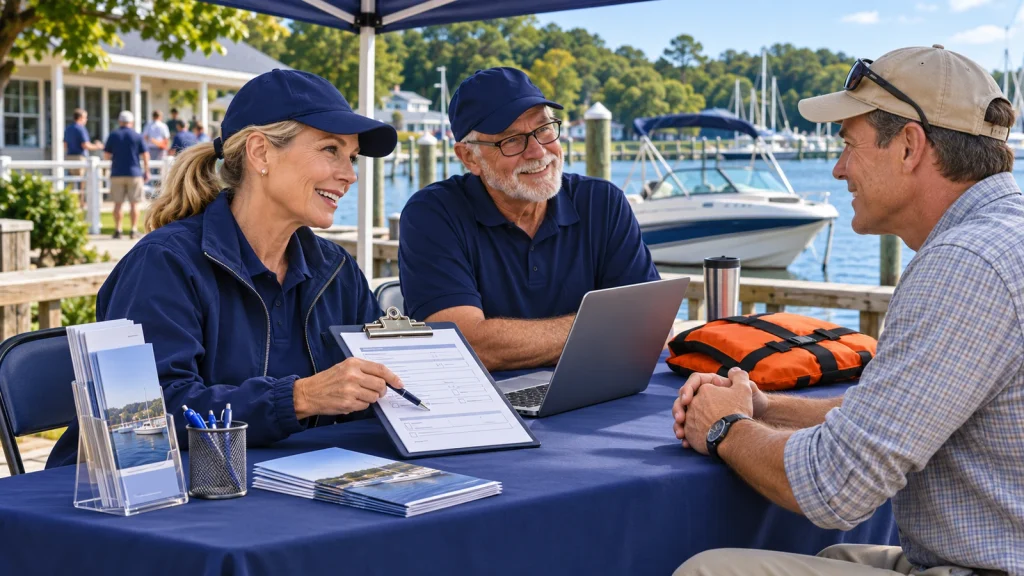
- Find a flotilla. Start with the official flotilla finder or submit an inquiry through the Auxiliary recruiting form. You need not choose the geographically closest flotilla.
- Attend a meeting or speak with membership staff. Find out what the unit actually does, how often it operates and whether someone can mentor you in your preferred role.
- Complete the enrollment paperwork. Follow the unit’s instructions for application forms, Association membership, dues and identity documentation.
- Complete screening and the New Member Exam. Follow the instructions for the personnel security investigation, including fingerprints. Approval-pending status may allow some activities with restrictions; it is not unrestricted clearance.
- Complete initial member training. Work through required Auxiliary Core Training and the orientation provided by the unit.
- Choose and qualify for a mission. Complete role-specific courses, practical tasks and evaluations as applicable.
- Begin authorized activities. Participate within your qualification and assigned authority; maintain required training and currency.
There is no guarantee of approval, a particular mission or a uniform processing timeline. I would visit more than one flotilla if the first cannot offer the kind of volunteering you are interested in.
Coast Guard Auxiliary training
Auxiliary training is not Coast Guard military boot camp. It is designed to prepare civilian volunteers for specific responsibilities, rather than turn them into enlisted personnel or commissioned officers.
Initial training introduces the organization’s rules and expectations. Core training continues according to the applicable requirements. Mission-specific training can then lead to qualifications such as vessel examiner, instructor, radio operator, boat crew member or coxswain. A coxswain qualification concerns responsibility for a boat and its crew, not a military rank.
Some courses are available online; practical operational tasks require demonstrated performance and evaluation. Section 5.26 of the Auxiliary regulations also permits access to certain Coast Guard courses when authorized. Ask the flotilla about instructor availability, prerequisites and the actual opportunities to practice your skills.
Does the Coast Guard Auxiliary deploy?
Yes, in the sense of authorized volunteer deployments and temporary duty, not military mobilization. The Chief Director’s July 2025 deployment guidance announcement explicitly covers Auxiliarists assigned away from their usual flotilla location under Coast Guard orders. It identifies hurricane relief and Southwest Border support as past examples.
Some volunteers may travel for training, disaster response or other authorized assignments. Such duties do not convert them into military members. The Auxiliary does not impose the same mobilization obligation as the military Reserve, and a new member should not expect an overseas assignment.
For the military meaning of the term, read how Coast Guard deployments work.
Is the Coast Guard Auxiliary worth joining?
It can be worth joining if you want to volunteer in maritime safety, develop relevant skills or support a Coast Guard unit without committing to military service. It is a poor substitute for a paid military job or a way to acquire military authority.
| Advantages | Limitations |
|---|---|
| Meaningful public safety work | No military pay or automatic military benefits |
| Training and specialist opportunities | Qualifications take time and must be maintained |
| No mandatory maximum enrollment age under published guidance | Operational duties still have performance requirements |
| Choice of flotilla and potential roles | Local mission availability and mentoring vary |
| Volunteer rather than military service obligation | Dues, travel and uniform costs may fall on you |
Questions to ask before you join
- What missions did this flotilla actually perform in the past year?
- Which qualification can I realistically work toward here, and who will mentor me?
- How often are patrols, vessel checks, classes or other activities available?
- What are the dues, uniform costs and recurring training requirements?
- What expenses are reimbursable and what assignments require advance orders?
These questions reveal more about the experience you’re likely to have than an impressive list of national programs.
Can Auxiliary members become active-duty Coast Guard members?
They can apply separately through normal military recruiting channels if eligible. Auxiliary membership is not an enlistment, a commission or an automatic conversion to active duty.
It does not guarantee selection, a particular military rating or advanced pay grade. If that is your objective, start with the military joining process and confirm current requirements with official recruiting.
Ultimately, the Coast Guard Auxiliary is a legitimate volunteer organization with a defined mission and real limits. Join it for the work you can contribute, not for military status. If the local flotilla offers useful assignments you are willing to train for, it may be an excellent fit.

Jeffrey Rogers has served in the United States Army for 18 years. Jeffrey served on overseas combat tours in Afghanistan and Iraq. Jeffrey Rogers was born in Norfolk, Virginia. He graduated in Information technology from George Mason University. Now, Jeffrey is the content head of Frommilitarybases.com.