
U.S. Coast Guard ranks run from Seaman Recruit (E-1) to Admiral (O-10). The service uses nine enlisted pay grades, three chief warrant officer grades and ten regular commissioned officer grades. Admiral is the highest rank, while Master Chief Petty Officer (E-9) is the highest enlisted grade.
I’ve separated the ranks into three charts so you can look up a uniform insignia, understand the chain of authority or find the pay grade without having to sort through unrelated military branches.
Coast Guard ranks in order, lowest to highest
Here is the overall hierarchy, following the official U.S. military rank insignia reference:
- Enlisted (E-1 to E-9): Seaman Recruit through Master Chief Petty Officer.
- Chief warrant officers (W-2 to W-4): Technical specialists and leaders in their professional fields.
- Commissioned officers (O-1 to O-10): Ensign through Admiral.
That is 22 distinct grades in the standard rank charts. Special titles within E-9 do not create extra pay grades. Academy cadets are also not an additional step in this hierarchy.
You do not have to advance through every category to become a commissioned officer. Many Coast Guard titles match the Navy’s, but the current warrant officer grades differ. Use the Coast Guard column when comparing the two services.
Coast Guard enlisted ranks and insignia
Enlisted Coast Guardsmen carry out the service’s missions, operate and maintain equipment, and develop into technical experts and leaders. The first three grades are junior enlisted; E-4 through E-6 are petty officers, and E-7 through E-9 are chief petty officers.
| Grade | Rank or rate (abbreviation) | Insignia identifiers |
|---|---|---|
| E-1 | Seaman Recruit (SR) | One diagonal stripe on the reference chart |
| E-2 | Seaman Apprentice (SA); Fireman Apprentice (FA); Airman Apprentice (AA) | Two diagonal stripes |
| E-3 | Seaman (SN); Fireman (FN); Airman (AN) | Three diagonal stripes |
| E-4 | Petty Officer Third Class (PO3) | One chevron below eagle and specialty mark |
| E-5 | Petty Officer Second Class (PO2) | Two chevrons below eagle and specialty mark |
| E-6 | Petty Officer First Class (PO1) | Three chevrons below eagle and specialty mark |
| E-7 | Chief Petty Officer (CPO) | Three chevrons and rocker; no star |
| E-8 | Senior Chief Petty Officer (SCPO) | Chief badge with one star |
| E-9 | Master Chief Petty Officer (MCPO) | Chief badge with two stars |
The insignia descriptions summarize the devices illustrated in the 2026 Coast Guard International Training Handbook. The exact device, color and location depend on the uniform.
For example, junior enlisted personnel may not display the illustrated stripes on every uniform. On traditional junior enlisted sleeve insignia, white stripes designate the seaman group, red the fireman group and green the airman group.
Junior enlisted: E-1 through E-3
Seaman Recruit is the entry-level rate. At E-2 and E-3, the seaman, fireman and airman titles reflect different occupational groups, not differences in seniority within the same grade. Recruits learn military customs and rank recognition during Coast Guard boot camp.
Petty officers: E-4 through E-6
Petty officers are enlisted leaders who perform specialized work and supervise other members. Their traditional sleeve rating badges use an eagle, a symbol for their occupational specialty and one, two or three chevrons.
Three chevrons identify a first class petty officer, not a chief unless the chief’s curved rocker is also present.
Chief petty officers: E-7 through E-9
Chiefs provide experienced enlisted leadership, mentorship and technical guidance. On collar devices, the chief’s insignia changes to a fouled anchor with a shield: no star for a chief, one for a senior chief and two for a master chief.
The service’s Master Chief Petty Officer of the Coast Guard uses a distinctive three-star chief device.
Command master chiefs and the Master Chief Petty Officer of the Coast Guard (MCPOCG) are senior enlisted leadership positions within E-9, not E-10 or E-11. The MCPOCG is the service-wide senior enlisted adviser to the Commandant.
The Coast Guard senior leadership directory identifies that office alongside the commissioned leadership.
Coast Guard warrant officer ranks
Chief warrant officers are commissioned technical specialists. They often bring substantial enlisted experience into officer-level assignments, but appointment is a separate competitive pathway, not the automatic promotion after master chief.
| Grade | Rank or rate (abbreviation) | Insignia identifiers |
|---|---|---|
| W-2 | Chief Warrant Officer 2 (CWO2) | Blue-and-gold bar, two gold breaks |
| W-3 | Chief Warrant Officer 3 (CWO3) | Blue-and-silver bar, one silver break |
| W-4 | Chief Warrant Officer 4 (CWO4) | Blue-and-silver bar, two silver breaks |
The Coast Guard currently uses W-2, W-3 and W-4. W-1 and W-5 appear in military-wide pay tables because other services use them; neither appears as a current Coast Guard grade in the official military rank chart.
A CWO’s specialty device can also identify the professional field. The rank bar and specialty device serve different purposes.
Coast Guard commissioned officer ranks
Commissioned officers lead personnel and direct operations, manage programs and exercise command when assigned to command positions.
Their responsibilities increase with experience, rank and assignment. The collar insignia below identify the rank; shoulder boards and dress sleeve stripes are alternative displays.
| Grade | Rank or rate (abbreviation) | Insignia identifiers |
|---|---|---|
| O-1 | Ensign (ENS) | One gold bar |
| O-2 | Lieutenant Junior Grade (LTJG) | One silver bar |
| O-3 | Lieutenant (LT) | Two silver bars |
| O-4 | Lieutenant Commander (LCDR) | Gold oak leaf |
| O-5 | Commander (CDR) | Silver oak leaf |
| O-6 | Captain (CAPT) | Silver eagle |
| O-7 | Rear Admiral (lower half) (RDML) | One silver star |
| O-8 | Rear Admiral (upper half) (RADM) | Two silver stars |
| O-9 | Vice Admiral (VADM) | Three silver stars |
| O-10 | Admiral (ADM) | Four silver stars |
Flag officers: O-7 through O-10
Rear Admiral (lower half), Rear Admiral (upper half), Vice Admiral and Admiral are flag officer ranks.
They are respectively one-, two-, three- and four-star officers. The abbreviations RDML and RADM are different: RDML identifies the one-star rank; RADM identifies the two-star rank.
What is the highest rank in the Coast Guard?
Admiral (ADM), pay grade O-10, is the highest Coast Guard rank. Its collar insignia consists of four silver stars. The Commandant of the Coast Guard is the service’s top leadership position and holds the rank of Admiral.
Commandant is a job title, not a separate rank above Admiral. The Vice Commandant also serves at the four-star grade.
The highest enlisted grade, E-9, is separate from the officer hierarchy. The MCPOCG advises the Commandant on enlisted matters; that position does not turn an enlisted member into a commissioned officer.
Rank, rate, rating and pay grade: what is the difference?
Coast Guard terminology can be confusing because the service uses naval-style titles. Here is how to read them:
- Rank: Military standing, particularly an officer’s title, such as Lieutenant or Captain. In everyday use, people also refer to enlisted ranks.
- Rate: An enlisted member’s grade or title, such as Petty Officer Second Class; the full rate may combine the rating and class, as in BM2.
- Rating: An enlisted occupational specialty, such as Boatswain’s Mate (BM) or Aviation Survival Technician (AST).
- Pay grade: The alphanumeric compensation classification, such as E-5, W-3 or O-4.
For example, BM2 identifies a Boatswain’s Mate Second Class at E-5. The BM identifies the rating, while the 2 identifies the petty officer class.
Two E-5 members can have different ratings but the same basic pay if their creditable service is the same. The official enlisted career directory identifies these specialties. Explore the different Coast Guard enlisted jobs and ratings to compare career fields.
A Coast Guard rescue swimmer, for example, serves in the AST rating; rescue swimmer is not a separate rank.
How to recognize Coast Guard rank insignia
Start by identifying the type of device rather than relying on its color alone. Chevrons normally indicate petty officers, anchors identify chiefs, blue-and-metal bars identify chief warrant officers, and bars, oak leaves, eagles or stars identify commissioned officer ranks.
On dress uniforms, officer sleeve stripes and shoulder boards convey the same grades in a different format.
Use the official rank chart when learning a specific uniform. A specialty emblem, qualification badge or Auxiliary office device may resemble military rank insignia without indicating that military grade.
Coast Guard ranks and pay
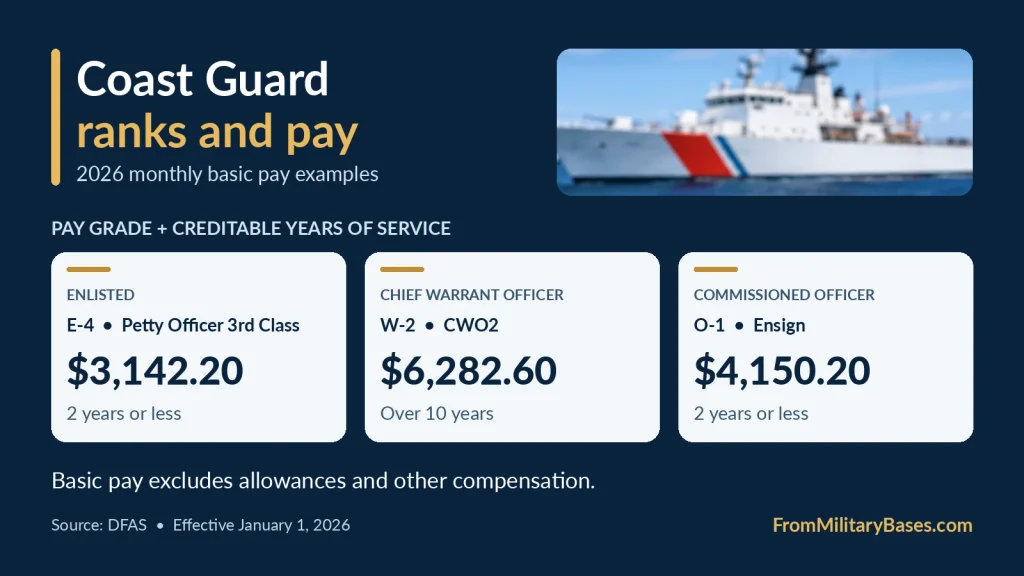
Coast Guard military basic pay follows the uniformed services’ pay schedule. Your grade and creditable years of service determine the applicable rate.
The following table gives one monthly active-duty basic pay example for each of the 22 grades, effective January 1, 2026. These are gross basic pay amounts, not starting salaries for every grade or estimates of total compensation.
| Pay grade | Creditable service column | Monthly basic pay |
|---|---|---|
| E-1 | 4 months or more; 2 years or less | $2,407.20 |
| E-2 | 2 years or less | $2,697.90 |
| E-3 | 2 years or less | $2,836.80 |
| E-4 | 2 years or less | $3,142.20 |
| E-5 | Over 6 years | $4,110.00 |
| E-6 | Over 6 years | $4,235.70 |
| E-7 | Over 10 years | $5,300.40 |
| E-8 | Over 16 years | $6,448.20 |
| E-9 | Over 20 years | $8,105.10 |
| W-2 | Over 10 years | $6,282.60 |
| W-3 | Over 14 years | $7,397.70 |
| W-4 | Over 20 years | $9,228.90 |
| O-1 | 2 years or less | $4,150.20 |
| O-2 | Over 2 years | $5,446.20 |
| O-3 | Over 4 years | $7,382.70 |
| O-4 | Over 10 years | $9,420.00 |
| O-5 | Over 16 years | $11,391.30 |
| O-6 | Over 20 years | $13,751.10 |
| O-7 | Over 20 years | $16,817.70 |
| O-8 | Over 22 years | $18,999.90 |
| O-9 | Over 20 years | $18,999.90 |
| O-10 | Over 20 years | $18,999.90 |
Sources: DFAS enlisted basic pay, warrant officer basic pay and commissioned officer basic pay. Each table is effective January 1, 2026.
How years of service change basic pay
You can earn more basic pay without changing grade. For example, an E-4 receives $3,142.20 per month with two years of service or less, versus $3,658.50 in the over-four-years column.
Pay increases stop at different longevity points for different grades. Time in service for pay is not necessarily the same as time in your current rank.
Three important exceptions to the examples above:
- An E-1 with less than four months of active duty receives $2,225.70 per month.
- The MCPOCG receives special E-9 basic pay of $11,166.90 per month while serving in that position, regardless of years of service; DFAS also specifies certain transition exceptions.
- Some O-1 through O-3 officers with qualifying prior enlisted or warrant officer service receive higher O-1E through O-3E rates. Those are pay classifications, not additional ranks.
The examples do not imply that a member automatically reaches a grade at the listed service milestone. DFAS also applies statutory pay caps; for O-7 through O-10 the 2026 basic pay cap is $18,999.90 per month.
Basic pay versus total military compensation
Basic pay is only one part of military compensation. Eligible members may also receive a Basic Allowance for Housing (BAH), Basic Allowance for Subsistence (BAS), special or incentive pays and noncash benefits such as health coverage.
Housing allowances depend on factors including duty location, pay grade and dependent status; eligibility and circumstances matter. Taxes, deductions and allotments can change take-home pay. Do not use the basic pay table as an estimate of what will reach your bank account.
How Coast Guard members advance
Enlisted advancement depends on meeting the applicable qualifications, performance standards and service requirements, and on selection or available advancement opportunities.
Depending on the grade and program, members may need occupational training, qualification sign-offs, an examination or a selection process. Becoming a chief warrant officer or commissioned officer involves a separate application and selection route.
The Coast Guard’s workforce and advancement overview explains the categories. Commissioned officer entry routes include the Coast Guard Academy, Officer Candidate School and direct commission programs for qualified applicants.
Officers advance through applicable selection and appointment processes; neither years of service nor a particular job guarantees promotion.
There is no universal timeline to E-5, and a bachelor’s degree alone does not automatically make someone an Ensign: commissioning requires selection and completion of the applicable program.
If you are deciding how to enter the service, see how to join the Coast Guard and the official officer career paths. For aviation specifically, the guide to becoming a Coast Guard pilot explains the commissioning and aviation training route.
Do Coast Guard Reservists have the same ranks?
Yes. The military Reserve uses the same rank titles and insignia as the active-duty Coast Guard. The key differences are duty status, pay calculation and applicable advancement opportunities.
A reservist performing ordinary inactive-duty drills is paid according to drill entitlement rather than receiving a full month of active-duty pay. When serving on qualifying active-duty orders, the applicable active-duty rates apply.
For the financial differences, see Coast Guard Reserve pay and benefits, and use the DFAS pay tables for the applicable duty status.
Coast Guard Auxiliary ranks and offices
The U.S. Coast Guard Auxiliary is the service’s civilian volunteer component. Its members are not military personnel by virtue of Auxiliary membership and do not hold military rank simply because they wear an Auxiliary uniform or office insignia. Its organizational titles identify elected or appointed leadership responsibilities.
| Level | Office title | Abbreviation |
|---|---|---|
| Flotilla | Flotilla Commander | FC |
| Division | Division Commander | DCDR |
| District | District Commodore | DCO |
| National | National Commodore | NACO |
The Auxiliary Basic Qualification Course illustrates elected and appointed office devices. Other volunteers serve in appointed staff positions, such as Flotilla Staff Officer (FSO), Division Staff Officer (SO) and District Staff Officer (DSO).
Office devices may resemble military insignia, but Auxiliary identifiers, including an “A” on many devices, distinguish them. The exact colors and design depend on the office and uniform.
Under 33 CFR Part 5, particularly sections 5.5, 5.14 and 5.16, Auxiliary membership and leadership are distinct from military status, and members generally serve without compensation.
Do not translate a Flotilla Commander into a military Commander (O-5), or an Auxiliary Commodore into a military flag officer. An Auxiliary office does not entitle its holder to that military pay grade.
Whether you are preparing for boot camp, comparing career options or identifying a uniform, the most useful distinction is between military grade, occupational specialty and leadership assignment. Once those are separated, the Coast Guard’s rank structure is much easier to read.

Jeffrey Rogers has served in the United States Army for 18 years. Jeffrey served on overseas combat tours in Afghanistan and Iraq. Jeffrey Rogers was born in Norfolk, Virginia. He graduated in Information technology from George Mason University. Now, Jeffrey is the content head of Frommilitarybases.com.