
Yes, the U.S. Coast Guard deploys. Coast Guard members can spend time away from home on domestic patrols, overseas maritime missions, disaster response assignments and military operations. Some serve aboard cutters for weeks or months, while others work primarily at a local shore unit.
Not everyone deploys overseas, and there is no single deployment schedule for the entire Coast Guard. Your experience depends on your assigned unit, job, mission and whether you serve on active duty or in the Reserve.
The Coast Guard’s Sea Legs deployment guidance describes absences ranging from days to months. Longer assignments and mobilizations are also possible. If you’re deciding whether to join, I’d focus on the kind of unit you could serve with, rather than assume that the Coast Guard has one predictable deployment cycle.
What counts as a Coast Guard deployment?
In everyday conversation, Coast Guard members may describe an extended cutter patrol or an assignment away from their normal workplace as a deployment. However, different types of military orders and operational assignments have different implications for members and families.
| Type of service | What it means |
|---|---|
| Cutter patrol | A vessel leaves homeport to carry out missions. An extended patrol may be described as a deployment, even if the cutter never visits a foreign country. |
| Operational deployment | A unit, team or individual goes away from its usual duty location to support a mission or contingency. |
| Temporary duty (TDY) | Official travel away from the permanent duty station, which may be for an operation, training, inspection or other work. |
| Permanent change of station (PCS) | Orders to a new permanent duty station, including an overseas location. A PCS tour is not the same as an operational patrol. |
| Emergency response | Personnel or assets are sent to assist during a disaster, pollution incident or other emergency, potentially on short notice. |
| Reserve mobilization | Reservists are ordered to active duty to meet an operational requirement under applicable authority. |
These categories can overlap. A shore-based aircrew can perform a temporary overseas mission, while a member permanently assigned abroad can deploy from that duty station. The Coast Guard’s international assignments guidance addresses both overseas PCS orders and travel abroad.
A normal local boat patrol, overnight duty at a station or training course may still mean time away from your family. But none automatically amounts to an overseas deployment.
How often does the Coast Guard deploy?
Deployment frequency depends much more on your actual assignment than on the branch name alone. A cutter crew may spend recurring periods underway throughout a tour. A shore unit can work locally for much of its time, with temporary missions elsewhere as needed.
The Coast Guard’s recruiting guidance for families provides useful context: the largest cutters, which can be away from homeport for more than six weeks at a stretch, account for under 10% of Coast Guard jobs. That figure is about jobs on those cutters, not the percentage of members who ever deploy, serve overseas or spend six weeks away from home.
Deployment expectations by unit type
| Assignment | What time away can look like |
|---|---|
| Cutters | Recurring patrols. Smaller vessels may conduct shorter missions; larger ocean-going cutters can spend weeks or months away from homeport. Cutter fleet and staffing report. |
| Small boat stations | Mostly missions within a local operating area, with watch schedules, overnight duty and potential temporary assignments elsewhere. Local duty does not mean a nine-to-five schedule. Recruiting lifestyle guidance. |
| Air stations | Local search and rescue coverage, flights and duty watches, sometimes combined with missions away from the air station. Air Station Clearwater’s mission description illustrates both kinds of work. |
| Sectors and other shore units | Port security, incident coordination, vessel inspections and other regional work; travel or emergency response can take personnel away. Coast Guard mission overview. |
| Deployable specialized forces | Mission-driven assignments, exercises and rapid responses, potentially far from the team’s home unit. Official specialized-force descriptions. |
| Administrative and support units | Generally work at their assigned location, but temporary travel or operational support is possible. Support jobs aboard cutters deploy with their vessels. |
| Reserve units | Local training is common, with additional periods of active duty or mobilization for missions. Reserve career guidance. |
Even two cutters of the same class may have different schedules. Maintenance, crew availability, operational requirements and readiness all influence when a vessel gets underway. A June 2025 Government Accountability Office report documented staffing and maintenance challenges that affected cutter operations and crew workload.
Ask about the difference between the length of one patrol, total days away over a year and watch schedules when the unit is home. Those are separate measures of how much time you might spend with your family.
How long are Coast Guard deployments?
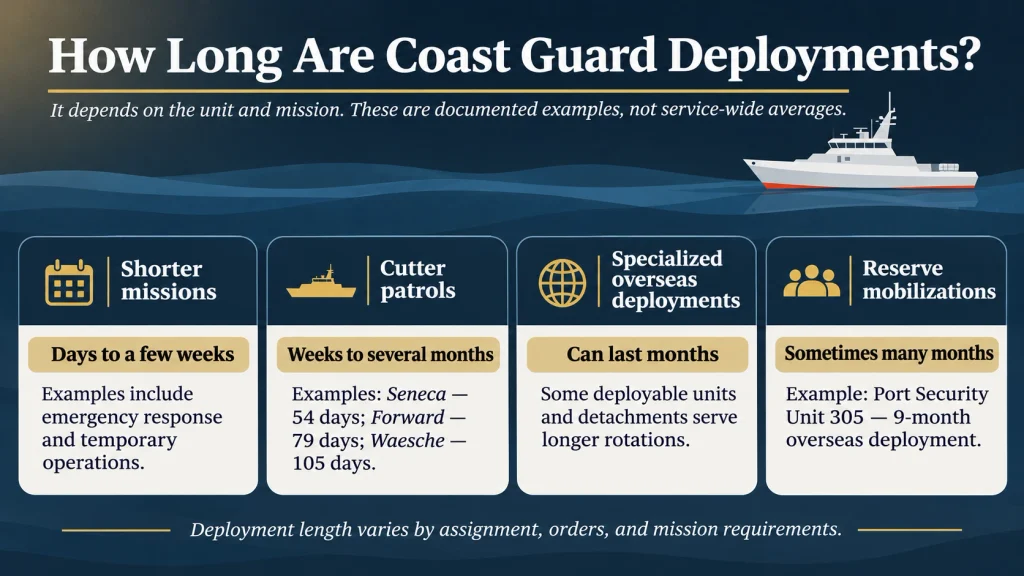
Coast Guard deployments can last a few days, several weeks or many months. A short emergency response has a different timeline from an offshore cutter patrol or an overseas port-security mission.
The following completed operations illustrate the range. They are actual examples, not service-wide averages or promises for future assignments.
| Documented mission | Time away |
|---|---|
| Reserve port-security team, Haiti earthquake response (2010) | 35 days, according to a 2010 GAO review. |
| Cutter Seneca, Windward Passage (2025) | 54 days on a maritime border security patrol. |
| Cutter Forward, Eastern Pacific (2025) | 79 days on a counterdrug patrol. |
| Cutter Waesche, Arctic (2025) | 105 days on a multi-mission deployment. |
| Port Security Unit 305, Guantanamo Bay (2022–2023) | Nine months supporting a joint military mission. |
Specialized teams may have a different pattern from cutter crews. A 2022 Coast Guard history of Law Enforcement Detachments (LEDETs) described deployments of 45 to 90 days, with some lasting up to six months.
That description concerns those teams at the time of the publication; it is not a current service-wide rotation policy.
Also, a permanent assignment lasting years is not a years-long deployment in the same sense. The Coast Guard’s family recruiting page describes normal duty-station tours as lasting two to four years, while a 2024 GAO study of duty-station rotations identifies a wider range of one to four years based on assignment type. During a single tour, members may complete multiple patrols or temporary missions.
Where does the Coast Guard deploy?
The Coast Guard operates in U.S. coastal and inland waters as well as internationally. Its responsibilities include protecting shipping, enforcing maritime laws, supporting national defense, responding to emergencies and cooperating with other countries.
These are representative operating regions and missions, not a list of current ship positions or upcoming deployments.
| Region | Examples of missions |
|---|---|
| United States and Great Lakes | Search and rescue, port security, fisheries enforcement, ice operations, navigation aids and environmental response. Official mission programs. |
| Caribbean | Maritime border security, rescues and interdiction, including Seneca’s 2025 Windward Passage patrol. |
| Eastern Pacific | Counterdrug and other maritime law enforcement operations, such as Forward’s 2025 patrol. |
| Alaska and Arctic | Maritime safety, sovereignty, fisheries and national defense; for example, Waesche’s 2025 Arctic deployment. |
| Pacific and Indo-Pacific | Maritime security and cooperation with partner nations. The July 2026 expeditionary squadron announcement documents a Western Pacific mission transition. |
| Europe and Africa | Marine inspections and international port security engagements by Activities Europe. |
| Middle East | Historical maritime security and interdiction support from Bahrain, beginning with the Iraq War era. See the dated update below. |
International operations help protect the maritime approaches to the United States, support commerce and maritime safety, and contribute capabilities to joint military operations. For a broader overview of the service’s responsibilities, see the Coast Guard’s roles and missions.
What happened to the Coast Guard’s Bahrain-based mission?
Patrol Forces Southwest Asia (PATFORSWA) was established in 2003 to support Operation Iraqi Freedom and subsequently operated from Bahrain. On July 15, 2026, the Coast Guard announced that its Expeditionary Cutter Squadron, historically known as PATFORSWA, transitioned to the Western Pacific.
Older descriptions of the squadron’s permanent presence in Bahrain should therefore not be treated as a current assignment roster. This announcement concerns that particular squadron; it does not establish that all Coast Guard activity in the Middle East has ended.
Does the Coast Guard deploy overseas?
Yes. Coast Guard cutters, aviation crews, specialized teams and individual members can deploy overseas. Members also receive permanent international assignments, including marine inspection and maritime security positions.
For example, Activities Europe personnel are based in the Netherlands and travel for work throughout Europe, Africa and parts of the Middle East. The service’s force overview also identifies Activities Far East and positions supporting joint military commands. These are examples of international duties beyond going to sea aboard a cutter.
Not all Coast Guard members deploy overseas. The official recruiting site says volunteers generally fill overseas opportunities. That is not a guarantee that you can decline every overseas order or stay in the United States throughout your career. The Coast Guard can assign personnel according to its requirements.
A domestic duty station does not prevent you from deploying abroad, either. Air Station Clearwater’s official mission description includes operations outside its home area, and shore-based inspectors and emergency response specialists can travel internationally.
Members stationed in Alaska or Hawaii are outside the contiguous United States, but are still serving within the United States; those assignments are not foreign postings.
Does the Coast Guard deploy to war?
Yes. The Coast Guard can support armed conflicts and serve in combat environments. It is a military service at all times under 14 U.S.C. § 101, not only when the country is at war.
The Coast Guard normally belongs to the Department of Homeland Security (DHS). Under 14 U.S.C. § 103, it operates as a service in the Navy if Congress directs that in a declaration of war or the President orders the transfer. An executive order transfers it back to DHS. War alone does not automatically trigger the transfer.
The Coast Guard can also support military commands without the entire service transferring to the Navy. A 2021 GAO review explains how Coast Guard vessels and aircraft supported defense requirements through multiple mission areas during fiscal years 2011–2020, not just the designated defense-readiness mission.
Has the Coast Guard seen combat?
Yes. The service’s official Vietnam War history describes Coast Guard patrol boats and larger cutters carrying out combat and interdiction missions, alongside personnel supporting port security, navigation and rescue. In the Iraq War era, PATFORSWA supported military maritime operations, and Coast Guard personnel also served on land in Afghanistan.
Serving in a conflict zone does not mean every member has an infantry or direct combat assignment.
A member may be responsible for protecting a port, inspecting hazardous cargo, maintaining equipment or supporting a joint command. Maritime law enforcement, which involves enforcing laws at sea, is also distinct from military combat, even when both involve significant danger.
Does the Coast Guard deploy to Haiti?
Yes. Coast Guard missions involving Haiti have included disaster relief and maritime interdiction. These are different operations, and the service’s presence in one does not establish a current deployment for another.
- 2010 earthquake: Port Security Unit 313’s official deployment history identifies Haiti among its overseas missions. The response also included other Coast Guard assets and personnel.
- 2021 earthquake: The August 15, 2021 Coast Guard release documents helicopters and personnel helping transport medical supplies and evacuate injured people in Haiti after the magnitude 7.2 earthquake. Its photographs and captions identify forward-deployed aircrews from Air Station Clearwater working in Port-au-Prince, while cutters supported relief offshore.
- 2025 maritime interdiction: Cutter Spencer’s September 2025 operation involved returning people to Haiti following interception of an overloaded vessel in international waters. The release also identifies a Coast Guard liaison officer assigned to the U.S. Embassy in Port-au-Prince.
Operating near Haiti is not the same as being deployed on Haitian land. The 2021 humanitarian operation provides specific evidence of personnel working inside the country; the maritime examples concern patrol and interdiction missions offshore.
Did the Coast Guard deploy to Afghanistan?
Yes, in a specialized support role. Coast Guard personnel served on land in Afghanistan during the war, even though Afghanistan has no coastline.
The Coast Guard Historian’s Office documents a Redeployment Assistance and Inspection Detachment (RAID) team at Bagram Airfield in 2009–2011. The team inspected equipment and hazardous cargo being sent home from the combat theater, including shipments at other bases in Afghanistan.
This was a specialist logistics and inspection mission in a dangerous environment, rather than a conventional large-scale Coast Guard ground combat deployment. It is an example of how the service’s technical expertise can support military operations far from the sea, not evidence of a present-day deployment to Afghanistan.
Yes. Coast Guard personnel can be stationed at Navy installations, temporarily deploy to them or work alongside Navy units. The distinction is whether the location is their regular duty station or a temporary mission away from home.
- Permanent unit: Air Station Ventura was commissioned at Naval Base Ventura County in California in November 2024. It is a Coast Guard air station on a Navy installation, not an overseas deployment.
- Temporary joint mission: Port Security Unit 305 completed its nine-month mission at Naval Station Guantanamo Bay in 2023. It was the unit’s final mission supporting Joint Task Force Guantanamo there; the example is historical.
- Aboard Navy vessels: Law Enforcement Detachments have embarked on U.S. Navy and allied vessels for maritime enforcement missions, as the Coast Guard’s LEDET history explains.
For geographical context, see the directory of Coast Guard bases and stations. Verify any particular unit’s present status with the Coast Guard before planning a move, especially when consulting older overseas listings.
Does the Coast Guard Reserve deploy?
Yes. Reservists can deploy domestically and overseas, even if their normal assignment is close to home.
According to the official Reserve recruiting page, a typical Reserve assignment involves two days of training each month and two weeks annually. That is the usual training commitment described for recruits, not an upper limit on military service.
Reservists may volunteer for active-duty assignments or be ordered to active duty without their consent when applicable law allows.
For instance, 10 U.S.C. § 12302 provides for involuntary Ready Reserve activation under specified conditions, and 14 U.S.C. § 3713 authorizes emergency augmentation of regular Coast Guard forces during qualifying incidents. The applicable authority, duty category and orders determine the obligation.
Port Security Units and other Reserve assignments
Port Security Units are expeditionary units staffed predominantly by reservists. Their official recruiting description says PSU assignments generally involve a weekend of training each month and four weeks per year, with potential activations of several months for major exercises or contingencies.
Reservists outside PSUs may also mobilize for disaster response, coastal security or other needs. Your normal drill schedule is not a reliable estimate of how often you could be called away. Ask about the specific Reserve billet and unit, not only about the rating.
Which Coast Guard jobs involve the most deployments?
There is no dependable public ranking of ratings by deployment frequency. However, it is possible to identify assignments where time away is built into the mission.
A rating is an enlisted occupational specialty; a billet is a particular position at a unit. A machinery technician assigned to a cutter and another assigned to a shore facility have the same rating but may live very different schedules.
- Cutter operations and engineering: Boatswain’s mates (BMs), machinery technicians (MKs), operations specialists (OSs), and other cutter personnel can spend extended periods underway.
- Aviation: Pilots, aviation maintenance technicians (AMTs), avionics electrical technicians (AETs) and aviation survival technicians (ASTs) may support missions at home or away. Not every aviation job deploys with a cutter.
- Maritime law enforcement: Maritime enforcement specialists (MEs) and other qualified personnel may serve in deployable boarding or security teams.
- Prevention and response: Marine science technicians (MSTs) can conduct local inspections or participate in incident response, including work away from their normal station.
- Support: Culinary specialists (CSs), storekeepers (SKs), yeomen (YNs) and other support personnel may have shore or operational assignments. A cook aboard a cutter goes where that cutter goes.
The official enlisted career directory explains the duties of each rating. It is a starting point for asking about afloat and ashore opportunities, not a deployment-probability chart.
Deployable specialized forces
Several types of Coast Guard units are specifically organized for missions requiring specialized capabilities away from their home units. These include Tactical Law Enforcement Teams (TACLETs), Maritime Security Response Teams (MSRTs), Maritime Safety and Security Teams (MSSTs), Port Security Units (PSUs), and the National Strike Force (NSF).
These organizations have different responsibilities, ranging from high-risk maritime law enforcement to oil spill and hazardous-material response. They are not interchangeable combat units. See the Coast Guard’s specialized forces overview for the mission distinctions.
Do Coast Guard officers deploy?
Yes. Officers can deploy when their assignments require it, including aboard cutters, in aviation operations, at expeditionary units and in military support roles. Commissioning as an officer does not exempt someone from deployments. The official Afghanistan history, for example, documents the work of the officer in charge of the RAID team.
Both services operate ships and aircraft and deploy internationally, but their missions and unit structures differ.
The Navy is organized primarily around naval warfare and maritime military power, while the Coast Guard also conducts extensive domestic law enforcement, safety and emergency response work.
Military OneSource’s deployment overview describes Navy deployments aboard ships and submarines as generally six or seven months, sometimes longer. It also describes a wide range for individual Navy assignments away from ships. For the Coast Guard, it emphasizes variation by mission and unit.
That difference matters if you are comparing the services, but a Coast Guard cutter crew or expeditionary member can still experience a lengthy absence. It would be misleading to assume every Coast Guard member deploys less than every Navy sailor. Compare the actual billets and platforms available to you.
What should recruits and Coast Guard families expect?
Before signing an enlistment agreement or applying for an officer program, I would ask an official Coast Guard recruiting representative about likely first assignments and the range of possible career paths. You can learn about the joining process in this Coast Guard recruitment guide, and consider time away alongside the other pros and cons of Coast Guard service.
Can you join the Coast Guard without deploying overseas?
It is possible to serve without an overseas deployment. You may prefer jobs and units that operate primarily in the United States, but you cannot infer a career-long geographic guarantee from that preference.
Members can submit assignment preferences. A GAO review of the duty-station process describes the Coast Guard collecting unit requirements and personnel preferences before issuing assignment orders.
Unless a specific commitment is included in applicable written enlistment or assignment documentation, do not treat it as guaranteed. Even a guaranteed initial location would not by itself exempt you from temporary missions.
Questions to ask before joining
- Which afloat and shore billets are available for the rating or officer specialty I’m considering?
- What has time away looked like for members in comparable assignments, including patrols and overnight watches?
- Can the unit send personnel elsewhere on temporary duty or emergency missions?
- Which first-assignment or training commitments, if any, can be documented in writing?
- For Reserve service, what additional training and mobilization obligations apply to this unit?
- Who provides family assistance before, during and after deployments?
Preparing for time apart
Families should make arrangements for childcare, bill payments, access to important documents, emergency contacts and household responsibilities before a member leaves. Discuss legal documents such as powers of attorney with an appropriate legal assistance office if needed.
Communication at sea may be less consistent than communication from a shore assignment. Ask the unit about approved communication channels and family support arrangements, without requesting or sharing nonpublic movement details.
The Coast Guard Ombudsman Program provides a connection between commands and families, including information and referrals. The Coast Guard’s Sea Legs guide and Military OneSource deployment resources cover preparation and reunion.
Ultimately, the Coast Guard offers both locally focused work and missions far from home. If staying near family is a priority, evaluate the likely assignments, ask about operational demands and understand which commitments are actually documented. The possibility of deployment remains part of military service, including in the Coast Guard.

Jeffrey Rogers has served in the United States Army for 18 years. Jeffrey served on overseas combat tours in Afghanistan and Iraq. Jeffrey Rogers was born in Norfolk, Virginia. He graduated in Information technology from George Mason University. Now, Jeffrey is the content head of Frommilitarybases.com.