
The U.S. Coast Guard Auxiliary does not have military ranks. Instead, its volunteer members hold elected or appointed offices, such as Flotilla Commander, District Commodore and National Commodore.
They wear distinctive insignia to identify those offices, not to indicate a military pay grade or commission.
The highest elected Auxiliary office is National Commodore (NACO). At the local level, the Flotilla Commander leads the flotilla, the basic unit of the Auxiliary. Members without an office are simply Auxiliarists.
That distinction is more than terminology: 33 CFR Part 5, particularly §§ 5.5 and 5.14, establishes elected and appointed leadership and expressly distinguishes Auxiliary insignia from military rank.
I’ve separated the offices by organizational level and by how they are filled, so you can identify a title without mistaking it for a military grade.
Read more: Is the Coast Guard Auxiliary a Joke?
Coast Guard Auxiliary ranks in order: leadership chart
The Auxiliary has four main administrative levels: flotilla, division, district or region, and national. Several district leadership positions are coordinated through national area leadership. The following chart shows the senior elected unit leader at each level, from local to national, rather than a promotion ladder.
| Level | Senior elected leader |
|---|---|
| Flotilla | Flotilla Commander (FC) |
| Division | Division Commander (DCDR) |
| District / region | District Commodore (DCO) |
| National | National Commodore (NACO) |
Source: 33 CFR § 5.5 and the Auxiliary Manual, COMDTINST M16790.1G, Chapters 1 and 4. The next tables expand this chart to include deputies and staff officers.
Coast Guard Auxiliary elected officers
Elected officers are chosen by the eligible voting members of the relevant unit or body. They are responsible for unit administration, coordination of activities, and communication with the people they represent.
A flotilla election is different from a national election; not every member votes directly for every position.
| Office and level | Principal role |
|---|---|
| FC — Flotilla Commander (flotilla) | Leads the local unit, coordinates its activities and appoints flotilla staff. |
| VFC — Flotilla Vice Commander (flotilla) | Assists the FC and coordinates staff and unit administration. |
| DCDR — Division Commander (division) | Leads the division and coordinates its constituent flotillas. |
| VCDR — Division Vice Commander (division) | Assists the DCDR and coordinates division staff. |
| DCO — District Commodore (district/region) | Leads the Auxiliary district or region and represents it at national level. |
| DCOS — District Chief of Staff (district/region) | Assists the DCO and coordinates district staff and leadership activities. |
| DCAPT — District Captain (district/region) | Coordinates assigned divisions and links division leaders with district leadership. |
| NACO — National Commodore (national) | Leads the volunteer organization nationally and presides over national leadership bodies. |
| VNACO — Vice National Commodore (national) | Supports the NACO and oversees Deputy National Commodores. |
| DNACO — Deputy National Commodore (national; three elected posts) | Coordinates assigned geographic areas and national programs. |
The vice offices are also commonly called Vice Flotilla Commander and Vice Division Commander. The national abbreviation is VNACO, not NAVCO or a military rank abbreviation.
Current national structure includes three elected DNACOs with Atlantic East, Atlantic West and Pacific area responsibilities. A fourth DNACO, for Information Technology and Planning, is appointed rather than elected.
See the July 2025 National Board and National Staff SOP, Section 1 and the national Deputy Commodore overview. Program portfolios may be reassigned across geographic posts.
Coast Guard Auxiliary appointed staff officers
Staff officers manage particular programs rather than being elected to lead an entire unit. Their duties and authority come from their appointment. For instance, a flotilla staff officer responsible for member training helps arrange instruction, while a public education staff officer coordinates boating safety classes.
| Office and level | Principal role |
|---|---|
| FSO — Flotilla Staff Officer (flotilla) | Manages an assigned local program. |
| SO — Division Staff Officer (division) | Coordinates an assigned program across flotillas. |
| DSO — District Staff Officer (district) | Manages a district-wide program. |
| ADSO — Assistant District Staff Officer (district) | Supports a DSO with delegated program duties. |
| DDC — District Directorate Chief (district) | Where used, coordinates a group of related district staff programs. |
| AUC — Auxiliary Unit Coordinator (district-appointed) | Coordinates Auxiliary support for an associated Coast Guard unit. |
| ASC — Auxiliary Sector Coordinator (district-appointed) | Coordinates Auxiliary support for a Coast Guard sector. |
| DNACO-ITP — Deputy National Commodore, Information Technology and Planning (national) | Oversees the assigned technology and planning portfolio. |
| ANACO — Assistant National Commodore (national) | Oversees assigned national functional areas and directorates. |
| ANACOd — Deputy Assistant National Commodore (national) | Assists the ANACO in the assigned portfolio. |
| DIR — Director (national) | Leads a national functional directorate. |
| DIRd — Deputy Director (national) | Assists in managing a directorate. |
| DVC — Division Chief (national) | Manages a functional division within a national directorate. |
| BC — Branch Chief (national) | Leads a branch within the national staff. |
| BA — Branch Assistant (national) | Supports an assigned branch. |
| N-A — National Commodore Administrative Assistant (national) | Provides administrative support to the NACO. |
| D-AA / D-AD — District Commodore Administrative Assistant / Aide (district) | Provides assigned administrative or aide support to the DCO. |
These are common or nationally documented office types, not every possible specialty assignment. Sources: Auxiliary Manual Chapter 4, Section G, Chapter 1, Section C, and the 2019 national uniform presentation, Auxiliary Insignia chart.
How parallel staffing works
Staff titles often have a functional suffix. For example, FSO-MT identifies a flotilla member training staff officer, while DSO-PE identifies a district public education staff officer.
The staff officer communicates with counterparts above and below the unit level, and reports through the applicable leadership structure. That is parallel staffing, not military command over everyone with a junior-looking device.
A national DVC is a Division Chief within a directorate; a local DCDR leads an organizational division containing flotillas. The titles describe different jobs even though both contain the word division.
Auxiliary leadership versus Coast Guard oversight
The Chief Director of Auxiliary (CHDIRAUX) and District Directors of Auxiliary (DIRAUX) administer the Auxiliary on the Coast Guard’s behalf.
They are not elected Auxiliary commodores. An Auxiliary unit leader exercises delegated administrative authority, while operational direction depends on the Coast Guard’s assignment to duty and the applicable mission rules. See the Chief Director’s leadership and policy resources.
Coast Guard Auxiliary rank insignia: how to identify an office
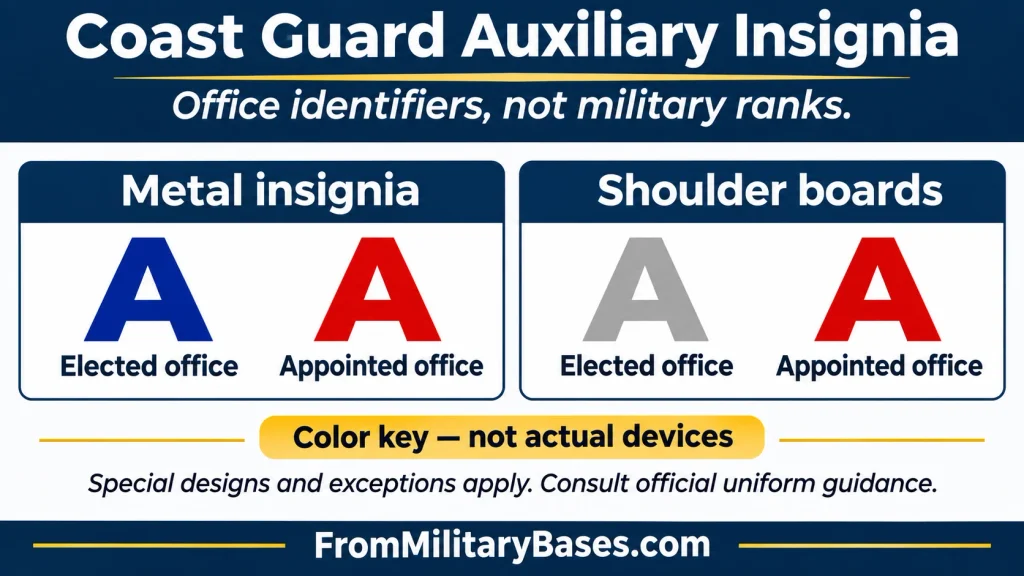
Auxiliary devices can resemble military officer insignia: bars, oak leaves, eagles, stars and sleeve stripes appear in office devices. Their distinctive markings and colors identify the Auxiliary. The appearance of a device does not confer the military grade it may resemble.
Start with the type of device. The color of the letter A does not have the same meaning on every uniform.
| Device | What to look for |
|---|---|
| Metal office insignia | Blue A for elected offices; red A for appointed offices. |
| Shoulder boards | Red A inside silver-colored shield for appointed officers; silver-colored A for elected officers. Commodore shoulder boards are an exception to the letter-A requirement. |
| Dress sleeve insignia | Silver lace and Auxiliary shield instead of the military gold lace. Commodores have distinctive silver stripe arrangements. |
| Sew-on office insignia | Black A regardless of elected or appointed status; color alone cannot identify the category. |
| Member device | Auxiliary emblem on collars for members who have never held office; member shoulder board has silver A and shield on blue. |
These rules come from Auxiliary Manual Chapter 10, Section F.1. A proposal to standardize office insignia to blue was rejected in ALAUX 013/24, so the distinction remains important.
Official office insignia charts
For visual identification, use the official illustrations alongside the office tables above. The charts are not military equivalency tables. Older illustrations can contain legacy titles or omit newer offices, so use the current policy and organizational references to resolve differences.
- Coast Guard Auxiliary Uniforms, revised December 2018, published as the 2019 presentation: locate the Auxiliary Insignia chart, which labels elected and appointed offices including DDC, ANACO and national staff positions.
- Basic Qualification Course Student Study Guide, January 2015: printed pages 113–114 show office categories and shoulder-board examples.
- Auxiliary Manual Chapter 11, Figure 11-4, printed page 11-59: collar and shoulder devices, cap ornamentation and selected breast devices. Some labels reflect earlier organizational terminology.
These visual references supplement the text chart rather than replacing current uniform policy. In particular, do not buy or wear a device based solely on an old chart.
Commodore sleeve insignia
Commodore offices have distinctive dress sleeve stripes. The Manual’s Chapter 10, Section F.1.c identifies the following combinations, with silver rather than gold lace:
| Office | Stripe arrangement |
|---|---|
| DCO, ANACO | One broad 2-inch stripe |
| DNACO, VNACO | One broad 2-inch stripe and one narrow half-inch stripe |
| NACO | One broad 2-inch stripe and two narrow half-inch stripes |
Several offices share a stripe arrangement. Neither stripe count nor insignia shape alone proves a specific office, military seniority or the authority to give orders on an operation.
Current office versus past officer insignia
An Auxiliarist may be authorized to wear insignia from a previously held office. When the device represents a past rather than current office, the applicable past officer device is required on uniforms that permit it.
The small silver past officer device does not itself distinguish elected from appointed service. The office device provides that distinction. Past officer devices are not worn on ODUs.
The National Help Desk’s past officer guidance explains the rule for members wearing insignia of a higher former office. The ODU insignia guidance explains the working-uniform exception. Check Chapter 10 for eligibility to retain an office device.
What is the highest rank in the Coast Guard Auxiliary?
The National Commodore is the highest elected Auxiliary leader. The NACO presides over the National Executive Committee (NEXCOM), which includes the VNACO, four DNACOs, the immediate past national commodore and the Chief Director of Auxiliary.
The National Board includes district commodores as well as other members specified in the national SOP.
The National Commodore is not the Commandant of the Coast Guard, a commissioned admiral or a military officer by virtue of holding the Auxiliary office. The Commandant retains statutory administrative authority. See 14 U.S.C. § 3901 and the national SOP.
What rank do new Auxiliary members start with?
Everyone enters at the member level. Prior military service and college degrees do not automatically give a new Auxiliarist an office or preferential advancement. The National Help Desk confirms this directly.
New enrollees may be in Approval Pending (AP) status while the personnel security investigation is completed. Membership status, including Initially Qualified (IQ), Basically Qualified (BQ) and advanced qualification designations, concerns screening or training rather than military grade. A person may become an experienced operational specialist without holding any elected or appointed office.
How to become a Coast Guard Auxiliary officer
Join a flotilla first through the official joining process. Applicants must be U.S. citizens at least 17 years old, complete the enrollment process and New Member Exam, and meet applicable security screening and Association membership requirements. See the official membership eligibility rules. Then complete the training required for your desired role. Election and appointment are distinct paths.
Getting elected
- Establish eligibility and remain in good standing. The Manual generally requires at least a year of membership before election as FC or VFC and qualifying prior elected service before advancing to higher levels.
- Complete required leadership courses. Effective January 1, 2025, candidates must complete the Administrative Procedures Course (APC) and either the Auxiliary Flotilla Leadership Course (AFLC) or Auxiliary Leadership and Management School (AUXLAMS), under ALAUX 013/24. Basic Qualification Course II is not a substitute.
- Meet the office-specific prerequisites, mandated training and applicable current program qualification requirements. A nominating committee verifies eligibility.
- Stand for election by the designated voting body. Winning an election, rather than merely completing training or serving a certain time, is what leads to elected office.
Most local elections occur annually, with newly elected non-national leaders assuming office January 1.
National elected terms run two years beginning November 1. District offices and other specific terms are governed by Appendix C; district elections for DCO are biennial. Interim vacancies have separate rules.
Waivers may be approved by the appropriate Director or Chief Director under the applicable policy; they are not automatic. See Chapter 4, Section F, Appendix C of the Manual, and the updated election eligibility guidance.
Getting appointed
Discuss available staff assignments with your unit leader. Appointments normally last for the appointing leader’s term unless ended earlier, and the duties should be provided in writing.
New members generally spend their first year developing experience; a unit leader can waive that waiting period for an appointment after a favorable personnel security determination. District staff appointments require the Director’s concurrence, and specified national appointments also require approval or concurrence.
Members in Approval Pending status are generally ineligible for office under Chapter 3, subject to authorized exceptions. Review Chapter 4, Section G before accepting an appointment. Prior civilian or military experience may be useful in performing a role, but it does not substitute for the applicable selection process.
Coast Guard Auxiliary ranks versus military Coast Guard ranks
| Military Coast Guard | Coast Guard Auxiliary |
|---|---|
| Enlisted, warrant or commissioned military grade | Civilian volunteer membership and offices |
| Military rank insignia | Auxiliary office or member insignia |
| Military advancement and commissioning processes | Election or appointment for offices |
| Military authority according to grade, billet and orders | Delegated organizational responsibilities and authorized mission duties |
| Military pay grade | No military pay grade; normally unpaid volunteer service |
Under 33 CFR § 5.16, Auxiliary members generally receive no compensation for their volunteer services, although authorized necessary travel expenses may be reimbursed.
If you want to identify actual military grades, see the Coast Guard ranks and military insignia guide. The Coast Guard military status explanation covers the legal distinction, and the Coast Guard Reserve pay and benefits guide explains paid military Reserve service.
U.S. Coast Guard Auxiliary uniforms
Auxiliarists wear authorized Coast Guard-style uniforms with Auxiliary-specific identification, not the military uniform without modification. The appropriate outfit depends on the event, duty and authorization. The following is a guide to common uniforms rather than a packing list.
| Uniform | Typical purpose or restriction |
|---|---|
| Operational Dress Uniform (ODU) | Operational work; embroidered Auxiliary identification and applicable devices. |
| Alternative Work Uniform (AWU) | Authorized alternative working outfit, with dark navy polo and tactical trousers; not a ceremonial uniform. |
| Tropical Blue | Light blue short-sleeve shirt and dark blue trousers or authorized equivalent; appropriate for specified service and public-facing duties. |
| Winter Dress Blue | Long-sleeve service uniform; authorized year-round under the 2024 amendment. |
| Service Dress Blue | Dress coat, service shirt and appropriate accessories for formal or service functions. |
| Dinner Dress Blue and jacket variants | Prescribed formal evening occasions, subject to authorization. |
| Service Dress White | Restricted to current and past district commodores, current and past NEXCOM members and currently certified Auxiliary chaplains under the 2024 policy. |
| Auxiliary Blue Blazer outfit | Authorized alternative apparel in appropriate settings; not a substitute for operational protective clothing. |
| Hot Weather Uniform, aviation and mission-specific clothing | Worn when authorized for the activity; includes approved operational or vessel examiner polo options. |
Consult AUX-PL-024(B), July 29, 2024, which updates the Manual’s Chapter 10. It names the Coast Guard Working Uniform (CGWU) alongside the ODU and prescribes the AWU as an alternative when those working uniforms cannot be obtained in the needed size or are unavailable. Policy recognition is not proof of retail availability.
Confirm current procurement and transition guidance through the Coast Guard uniform distribution information and your Auxiliary unit before purchasing.
When members wear office insignia and when they do not
Auxiliary-specific name tapes and devices help distinguish volunteers from military personnel. Under the 2024 policy, Auxiliarists assigned to duty as part of a Coast Guard unit crew normally wear member insignia, with exceptions for ceremonies or other wear authorized by the commanding officer.
For certain high-level liaison assignments, wearing highest-office insignia requires consultation and approval from the geographic DIRAUX.
On an authorized vessel examiner polo, office insignia and name tags are not worn. See the vessel examiner uniform guidance.
That means someone wearing a member device may be an elected leader or experienced staff officer. The uniform alone does not reveal the person’s complete service record.
U.S. Coast Guard Auxiliary logo, emblem and seal
The Auxiliary emblem features a circular ring bearing the organization’s name around a U.S. shield, backed by crossed anchors. It identifies the Auxiliary on authorized items, including member devices, publications, flags and patrol signs.
The Auxiliary mark is different: it incorporates a broad diagonal blue stripe with narrower white and red stripes and the emblem.
The official Auxiliary seal is a separate design used for authorized official documents and ceremonial purposes, not a general-use logo. The military Coast Guard emblem is also distinct, with the Coast Guard name and the year 1790. See the Auxiliary Manual, Chapter 5, Section I.5, Figures 5-1 and 5-2 and 33 CFR §§ 5.40–5.43.
For non-Auxiliary reproduction of markings, obtain approval from the Commandant’s designated Auxiliary office under § 5.40(c). A publicly accessible image is not permission to reproduce the emblem, seal or flag. If you need an official graphic, start with the source above rather than downloading an unverified logo from image search.
U.S. Coast Guard Auxiliary flag and ensign
Not every Auxiliary flag has the same purpose. The ordinary Auxiliary ensign identifies the organization or membership; the patrol ensign indicates an approved operational facility on patrol. Leader flags, pennants and burgees indicate specified leadership offices.
| Symbol | Identification and use |
|---|---|
| Auxiliary ensign | Blue field, broad diagonal white stripe and blue Auxiliary emblem. Members may display it under authorized conditions, including at qualifying vessels or homes. |
| Auxiliary patrol ensign | White field, broad red diagonal stripe, blue emblem and narrow white and blue stripes. Approved vessels display it on patrol, subject to Coast Guard ensign rules. |
| Coast Guard ensign | Separate military service ensign. An accepted vessel on patrol carrying a Coast Guard commissioned, warrant or noncommissioned officer displays it instead of the Auxiliary patrol ensign under § 5.47. |
| Leader flags or pennants | Identify current offices on inspected and approved surface facilities when the leader is aboard. |
| Past leader burgees | Identify eligible former officeholders under the vessel display rules. |
See 33 CFR §§ 5.40–5.47 and the Auxiliary Operations Process Guide, Volume I, 16798.31A, August 2023, Chapter 6. The latter explains display priority, restrictions, and the rule limiting a facility to one leader flag, pennant or burgee at a time.
The national ensign is still required in the applicable circumstances. The National Help Desk explains member ensign display at home and on vessels.
AUXOP and specialist qualification devices
Operational Auxiliarist (AUXOP) is an advanced training designation. The AUXOP device indicates successful completion of the program’s training requirements; it is not an office or a promotion. The current program uses seven credits across core, leadership and elective categories. The official policy and member resources explain the program.
Other qualification insignia identify earned specialties, for example Auxiliary coxswain, aviation, aircrew, marine safety (Trident) or recreational boating safety. Qualification and currency requirements depend on the individual program.
A qualified coxswain can have responsibility for a boat crew on an assigned mission without holding a flotilla office. Conversely, a flotilla commander is not automatically qualified to operate a patrol vessel.
On ODUs, the applicable guidance permits one permanent sew-on qualification insignia above the left Auxiliary tape and the AUXOP device, if earned, above the right name tape. See the National Help Desk’s sew-on qualification guidance. Consult the current program handbooks before treating a badge as proof of present operational currency.
Auxiliary customs and courtesies
Do Coast Guard Auxiliary members salute?
Saluting is not required between Auxiliarists. It is proper courtesy when greeting commissioned officers of the armed forces and the specified NOAA and Public Health Service uniformed officers.
When uniformed and covered, Auxiliarists may return a salute from a military member. Additional rules apply to national colors, ceremonies and boarding military vessels. See Auxiliary Manual Chapter 12, Section A and the official saluting guidance.
How are Auxiliary officers addressed?
Commodore is the appropriate formal title for the applicable Auxiliary commodore offices, abbreviated COMO in personal forms of address. Otherwise use the person’s name and actual Auxiliary office as appropriate.
An FC is a Flotilla Commander, not a commissioned Coast Guard Commander. Do not infer an entitlement to military courtesies from the similarity of an office device.
What is AuxOfficer?
AuxOfficer (also called AuxDirectory) is an Auxiliary member and organizational directory system, not an office title. Members looking for unit listings or account access should use the official AuxDirectory/AuxOfficer portal and the National Help Desk sign-in instructions.
The key to reading any Auxiliary uniform is to separate membership, leadership office and earned qualification. Together they tell you something about a volunteer’s service; none creates a military rank.

Jeffrey Rogers has served in the United States Army for 18 years. Jeffrey served on overseas combat tours in Afghanistan and Iraq. Jeffrey Rogers was born in Norfolk, Virginia. He graduated in Information technology from George Mason University. Now, Jeffrey is the content head of Frommilitarybases.com.