
Yes, the U.S. Coast Guard has a Reserve component. Officially called the Coast Guard Reserve, it allows qualified people to serve in the military while maintaining a civilian career or attending college. Most drilling Reservists train part time, but they can be called to full-time duty for emergencies, national defense and other Coast Guard missions.
Joining the Coast Guard Reserves is not simply a matter of finding a recruiting office and choosing a job. Your age, prior service, qualifications, local vacancies and willingness to mobilize all affect what you can do. I would start by identifying the actual job and unit you could join, then evaluating the training and financial commitment.
What is the Coast Guard Reserve?
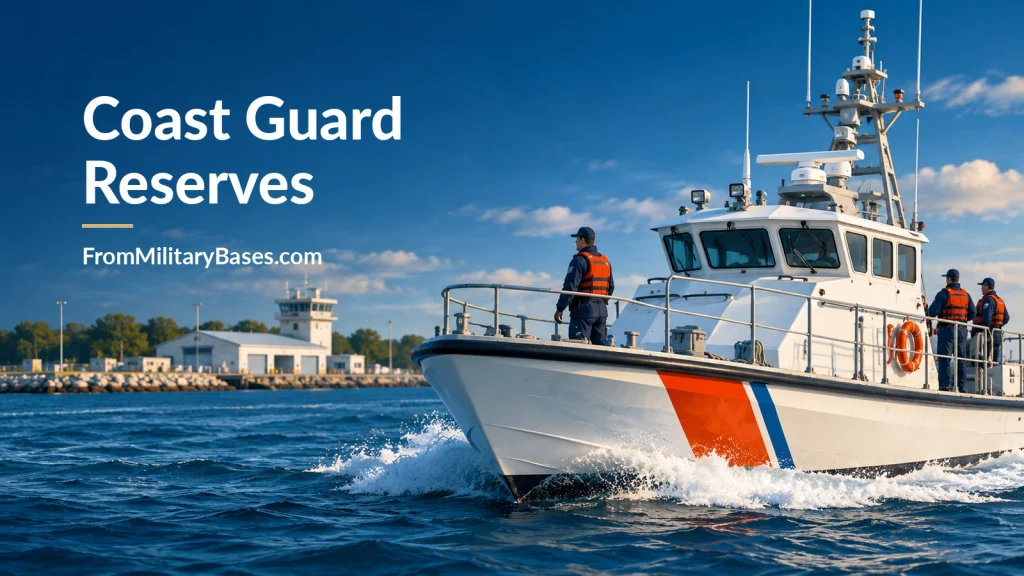
The Reserve is a military component of the U.S. Coast Guard, not a civilian volunteer organization. Its purpose is to provide trained personnel who can supplement the regular Coast Guard for maritime security, emergency response, defense readiness and other missions. Reservists may work alongside active-duty members or in deployable Reserve units.
The Coast Guard Reserve’s official overview explains this surge-force mission. The Coast Guard Auxiliary, by contrast, consists of civilian volunteers who support authorized Coast Guard activities. Auxiliarists do not become military Reservists by volunteering. See my guide to the Coast Guard Auxiliary and its responsibilities for that alternative.
Your Reserve category matters. Members of the Selected Reserve (SELRES) normally have assigned training responsibilities and receive pay for authorized paid duty. Members of the Individual Ready Reserve (IRR) are generally not assigned the same recurring paid drill schedule, but retain military obligations and may be recalled.
The Standby and Retired Reserve are separate categories with different participation and recall rules. This guide focuses primarily on joining and serving in the SELRES.
Coast Guard Reserve at a glance
| Question | What to expect |
|---|---|
| Age | Many first-time enlisted applicants: 17–40, depending on program. Officer programs have separate age rules. |
| Eligibility | Accession testing, education, medical, fitness and suitability standards; additional job requirements. |
| Training | Standard recruit training or an authorized alternative, specialty training and unit qualifications. |
| Time commitment | Typically recurring drills and annual training, plus initial training and possible activation. |
| Pay | Based on pay grade, creditable service and paid duty performed. |
| Deployment | Domestic or overseas duty, including involuntary mobilization when authorized. |
| Careers | Operational, technical and support roles, subject to available billets and qualifications. |
| Retirement | Normally 20 qualifying years for non-regular retirement; payments usually begin at age 60, with certain exceptions. |
These are starting points, not a universal contract. The official Reserve recruiting page and Coast Guard recruiting instruction, COMDTINST 1100.2I are useful references for the different ways to enter.
Coast Guard Reserve requirements and qualifications
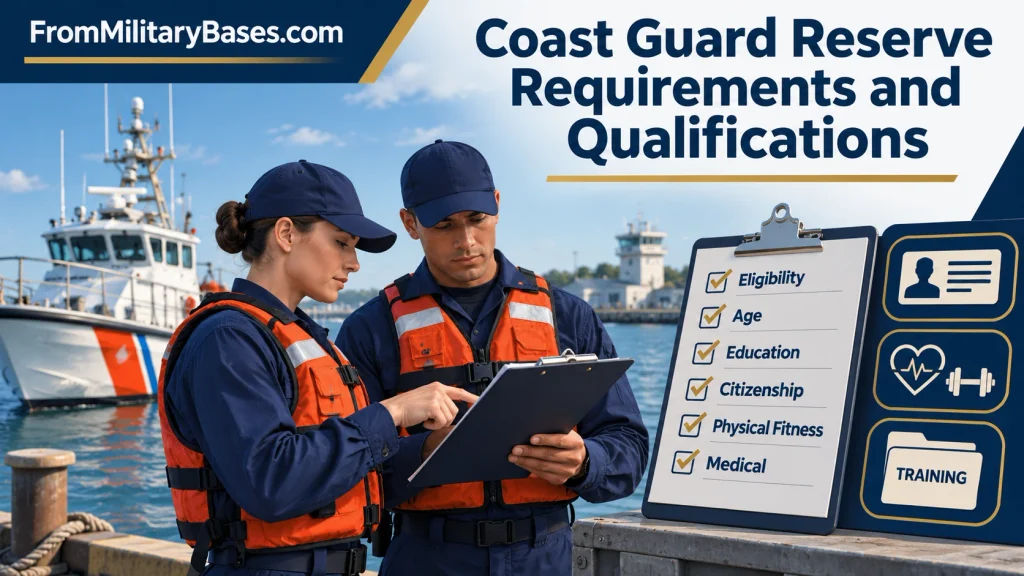
For enlisted entry, expect the recruiter to verify your age, citizenship or qualifying permanent-resident status, education, military aptitude, medical fitness and suitability for service.
Some roles require U.S. citizenship or security-clearance eligibility even when permanent residents may qualify for general enlistment. Officers must meet commissioning requirements, including U.S. citizenship.
- Education: A high school diploma is the normal route. Alternative credentials may require additional approval; not every education tier qualifies.
- ASVAB: The Coast Guard advertises a minimum general AFQT score of 32, but individual ratings and accession programs may require higher or different scores. DEPOT publishes a minimum of 45.
- Medical and physical standards: Complete accession medical screening, meet applicable body composition and fitness requirements, and prepare for swimming and physical training.
- Background: Disclose criminal history, financial obligations, drug history, dependents and previous military records as required. Security screening and waivers depend on the circumstances and job.
- Prior service: Your discharge, reenlistment eligibility, former grade, qualifications and remaining military obligation affect your options.
Check the official eligibility selector for your specific program rather than treating one set of requirements as applicable to everyone.
Coast Guard Reserve age limit: Can you join at 40?
Yes, age 40 can fall within the published enlisted age limits. It also falls within the standard age range for several Reserve officer programs. But the minimum age, age calculation and other requirements vary with the accession path.
| Entry route | Published age range or rule |
|---|---|
| RP or RK enlisted, no prior service | 17–40; applicants who are minors generally need parental or guardian consent unless an exception applies. |
| RX or RA enlisted, no prior service | 25–40; professional skills or qualifying education required. |
| RQ prior service, no remaining obligation | 25–40, subject to applicable service-credit and waiver provisions. |
| RN or RJ prior service, remaining obligation | 22–40, subject to applicable service-credit and waiver provisions. |
| SRDC, DCL-SELRES and DCPA-SELRES | 21–40 under the June 2025 instruction, measured on September 30 of the fiscal year in which the selection panel convenes. |
The enlisted rules allow a constructive-age calculation that can subtract up to 60 months of qualifying prior active service, excluding active duty for training.
Some prior-service age waivers may be considered, particularly for eligible applicants entering at E-4 or higher. That does not make 45 a universal maximum or guarantee approval. Officer waivers are governed separately.
These ranges come from Chapters 4, 6 and 7 of the June 2025 recruiting instruction. Ask the recruiter to calculate your age for your actual accession or selection date, especially if your next birthday is approaching.
Coast Guard Reserve tattoo policy
The Reserve follows the same service appearance instruction as active-duty members and applicants. COMDTINST 1000.1F, dated May 14, 2024, replaced the previous tattoo instruction.
- Body tattoos are generally permitted outside restricted locations. Tattoos promoting discrimination, extremism, violence, lawlessness or sexually explicit material are prohibited.
- One tattoo on the back of each hand may measure up to 2.5 inches in any direction, within the specified wrist-to-knuckle area.
- One finger tattoo per hand is allowed under placement restrictions. An encircling ring tattoo counts as that finger tattoo.
- One tattoo behind each ear may measure up to one inch, subject to the prescribed boundary and hairline restrictions.
- Face, head, neck, chest and palm restrictions apply, with limited exceptions such as authorized cosmetic tattooing or permitted ring tattoos.
A recruiter can submit a waiver request for tattoo size or placement. The instruction does not permit content waivers. Show the recruiter photographs of questionable tattoos before assuming you need removal or that a waiver will be granted.
Can you be colorblind in the Coast Guard Reserve?
Possibly, but the answer depends on the medical finding and your intended rating or commissioning program.
Some jobs require normal color perception because personnel must reliably distinguish signals, wiring or other visual information. For example, the published SRDC eligibility criteria include normal color vision.
General accession medical qualification does not automatically qualify you for every specialty. The Coast Guard must evaluate the actual test result and determine whether a waiver is available for the relevant standard.
Review the military medical accession standards and ask your recruiter which ratings are open to you after screening. Do not sign for a job on the assumption that a waiver will follow.
Coast Guard Reserve jobs and openings
A rating is an enlisted occupational specialty. A billet is an authorized position at a particular unit, with its own grade and qualification requirements. The distinction is important: a rating may exist throughout the Coast Guard without an available Reserve billet near you.
| Career area | Examples of ratings or work |
|---|---|
| Maritime operations | Boatswain’s Mate (BM), small-boat operations and seamanship; Operations Specialist (OS), communications and operational coordination. |
| Security and law enforcement | Maritime Enforcement Specialist (ME), security and authorized law enforcement duties after qualification. |
| Engineering and maintenance | Machinery Technician (MK), Electrician’s Mate (EM), Damage Controlman (DC). |
| Logistics and administration | Storekeeper (SK), Yeoman (YN), other authorized support positions. |
| Specialized technical and professional work | Information technology, intelligence, health services and qualified officer specialties, depending on the billet. |
These are examples, not a list of current vacancies. Consult the official enlisted career directory and my Coast Guard jobs and ratings guide for occupational descriptions. Ask your recruiter which specialties are accepting applicants through your particular Reserve accession program.
Port Security Units (PSUs) are deployable organizations that contribute to maritime defense and security. They offer operational and support assignments, and their readiness requirements can exceed the familiar drill-weekend schedule.
Other Reservists serve at shore-based units, supporting boat operations, marine safety, incident response, administration and technical work. Training, credentials and local staffing determine what you actually do.
How to find a Reserve opening near you
- Contact a Coast Guard recruiter and provide your location, education, prior service and preferred specialties.
- Request available Reserve billets within a realistic commuting distance, including the unit location and required pay grade.
- Ask whether the position is open to a new recruit, requires specialty school, or is reserved for an already-qualified member.
- For current Reservists, consult the assignment process through Reserve Personnel Management.
I would compare the actual commute and job before comparing ratings in the abstract. A desirable specialty three hours away may be a poor fit for someone whose civilian job requires weekend availability.
Can Coast Guard aviation ratings join the Reserve?
Yes, aviation opportunities exist, but they are not necessarily entry-level opportunities for people with no military aviation background.
The 2021 Reserve enlisted aviation workforce announcement established opportunities involving Aviation Maintenance Technicians (AMT), Avionics Electrical Technicians (AET) and Aviation Survival Technicians (AST) with existing Coast Guard experience and qualifications.
The original criteria included Basic Aircrew designation and separation from active duty within the two years preceding the announcement, with a waiver process. Its eligibility window was specific to that announcement. Do not use it as a current vacancy notice. Ask whether an enlisted aviation billet is available to someone with your qualifications today.
Officer aviation is a separate route. ALCOAST 340/26, the assignment year 2027 Reserve Aviator solicitation, describes opportunities for experienced Coast Guard aviators, with prior Coast Guard aircraft-command qualifications, flight experience, medical standards and selection requirements.
It does not establish an ab initio Reserve pilot program. A solicitation also does not establish that its positions remain vacant.
If your goal is to become a pilot or rescue swimmer from scratch, ask specifically about active-duty pathways, prior qualifications and whether eventual Reserve affiliation is realistic. The active-duty Direct Commission Aviator program is not the same as a Reserve aviator assignment.
Do Coast Guard Reservists serve on cutters?
They can, depending on assignment and orders. Reserve service is often shore-based, and working aboard a small boat is different from holding a permanent billet on a cutter.
The Coast Guard has documented temporary afloat assignments for Reserve personnel, including a 2024 example of a Reserve officer supporting cutter operations.
That example is not proof of currently available permanent underway Reserve billets. If you want sea duty, or need to know whether a position requires time away aboard a cutter, ask about that specific billet and possible mobilization assignments. No rating alone guarantees or rules out cutter service.
Coast Guard Reserve ranks
Reservists hold military pay grades within the Coast Guard’s enlisted, chief warrant officer and commissioned officer hierarchy. Enlisted ratings describe occupational specialties; pay grades describe seniority and compensation.
Advancement depends on applicable qualifications, performance and service advancement or promotion processes. See the Coast Guard ranks and pay grades guide for the complete hierarchy.
How to join the Coast Guard Reserve
- Speak to a recruiter. Establish whether you are applying as a new enlisted member, prior-service applicant or prospective officer.
- Check eligibility and vacancies. Determine your applicable program, age, qualifications and potential unit.
- Complete screening. Take required aptitude tests, attend medical processing, supply records and complete interviews or other screening.
- Review your offer. Understand the rating or billet, school dates, drilling commitment, remaining service obligation and any written incentives.
- Complete initial training. Attend the recruit or officer course and any required specialty school.
- Report to your unit. Complete local qualifications and establish your drill and annual training schedule.
The official enlistment guide explains several different Reserve entry routes. A general guide to joining the Coast Guard can also help you understand the broader process, but use the current official program requirements for your eligibility decision.
Enlisted Reserve accession programs
The recruiting instruction distinguishes several paths according to prior service, education, civilian skills and training needs. Here is how to choose which to discuss with a recruiter.
| Program | Intended applicant and training |
|---|---|
| RP | New recruit available for consecutive basic and specialty training. |
| RK | Qualifying student needing an approved split-training arrangement. |
| RX | Applicant with relevant civilian qualifications; DEPOT and additional school as required. |
| RA | Applicant with qualifying college credits entering a designated rating through DEPOT and specialty training. |
| RQ | Prior-service applicant without remaining military service obligation; DEPOT normally required, with specified prior-Coast Guard exceptions. |
| RN | Prior-service applicant with remaining obligation; applicable DEPOT and service commitment. |
| RJ | Eligible prior Coast Guard member with remaining obligation; no additional initial active-duty training under this pathway. |
For RA, the June 2025 instruction specifies at least 60 semester or 90 quarter hours of qualifying college credit. RX depends on rating-approved professional credentials, not merely having a civilian job.
Prior-service accessions may retain or receive a grade only under the applicable approval process. Bring your DD Form 214 and related service records to the recruiter.
How to become a U.S. Coast Guard Reserve officer
You do not necessarily have to enlist before applying for a Reserve commission. The Coast Guard publishes several Selected Reserve officer pathways, including:
| Program | Who should investigate it |
|---|---|
| Selected Reserve Direct Commission (SRDC) | Applicants with a qualifying bachelor’s degree or eligible Coast Guard enlisted applicants meeting specific grade and education exceptions. Operational and support leadership roles depend on assignment. |
| Direct Commission Lawyer–SELRES | Qualified attorneys interested in Reserve legal service. Confirm any current law-student entry option and bar admission requirements. |
| Direct Commission Physician Assistant–SELRES | Applicants with qualifying degrees, accredited PA training and the required professional credentials; clinical experience is preferred. |
Under the June 2025 instruction, all three have a standard minimum four-year SELRES commitment. The recruiting website also describes a lawyer pathway for applicants in their final year of law school with separate bar-admission and obligation conditions.
Because the public descriptions differ in scope, verify that option with the current selection authority rather than assuming student eligibility. The instruction limits non-Coast Guard active military service to 12 years for these programs; the SRDC public eligibility selector also lists a cumulative service condition.
Applications generally involve an officer package, interview, medical qualification and competitive selection.
SRDC and applicable lawyer selectees attend five-week Reserve Officer Candidate Indoctrination (ROCI); physician assistant selectees follow the designated direct commission course.
Prior commissioned service can affect the training requirement. Consult the official direct commission program descriptions and Chapter 7 of the recruiting instruction before applying.
Coast Guard Reserve boot camp and training
New enlisted Reservists may attend the same standard eight-week recruit training course at Training Center Cape May as active-duty recruits.
Some qualified prior-service and professionally experienced applicants can attend Direct Entry Petty Officer Training (DEPOT), a 20-day course. DEPOT is an accession program, not an automatic benefit of joining the Reserve.
After recruit training, you may attend A-School for your rating, and additional courses or supervised qualification work at your unit.
A school can add weeks or months to your initial absence from civilian employment or school. Some applicants are authorized to split training, while others need to be available for consecutive courses.
Review the official basic training overview, Cape May DEPOT requirements and the Coast Guard boot camp guide. Ask about actual school availability before making commitments to an employer or registering for a college semester.
How long is a Coast Guard Reserve contract?
Separate the total military obligation from the number of years you must participate in the Selected Reserve.
Under the recruiting instruction, the non-prior-service enlisted RP, RK, RX and RA routes generally involve an eight-year enlistment with at least six years of SELRES participation. The remaining portion may be served in an authorized inactive status, often the IRR.
Prior-service applicants have different contract options and program minima. The instruction permits several enlistment lengths, including two through six years and eight years as applicable, but RQ and RN have minimum participation requirements and RN must account for remaining service obligations. Officer programs have separate service agreements.
A bonus can add eligibility, service and repayment conditions. Before signing, get the applicable obligation, initial training requirements, rating assignment, incentives and consequences of early separation in writing.
The recruiting instruction’s Reserve accession chapter provides the program framework; your signed agreement determines your individual commitment.
Coast Guard Reserve drill and time commitment
The familiar model is one drill weekend per month and approximately two weeks of annual training. A conventional weekend consists of four paid inactive-duty training (IDT) periods. A drill period is not the same as an entire calendar day.
The Reserve Duty Status and Participation instruction, COMDTINST 1001.2A, provides a general framework of 48 paid IDT periods and 12 days of active duty for training (ADT) per fiscal year for ordinary SELRES participation, subject to applicable authorizations and exceptions. Annual fiscal-year guidance may change available funding and scheduling requirements.
A drill schedule is not a guarantee that you will work only two days each month. Units may consolidate training, require additional qualifications or schedule duty on other days.
Initial training, travel, medical readiness requirements and mobilization can substantially increase time away from home. Ask the unit which duty and travel expenses are authorized; do not assume commuting is fully reimbursed.
What is Coast Guard Reserve life like?
Between periods of duty, many Reservists work or study as civilians. During training and activation, they must meet military readiness and performance requirements. A unit’s actual schedule, distance from home and mission can make two Reserve careers very different.
The Uniformed Services Employment and Reemployment Rights Act (USERRA) protects eligible employees against service-related discrimination and provides reemployment rights when statutory conditions are satisfied.
It does not guarantee that a civilian employer will pay your normal wages during military absence or eliminate every scheduling conflict.
Before joining, estimate the commute, childcare arrangements and the financial effect of an extended military absence.
Ask the unit for a representative annual training calendar and how far in advance drill dates are normally announced. Build your civilian plan around real availability rather than an advertising slogan.
How much do Coast Guard Reservists get paid?
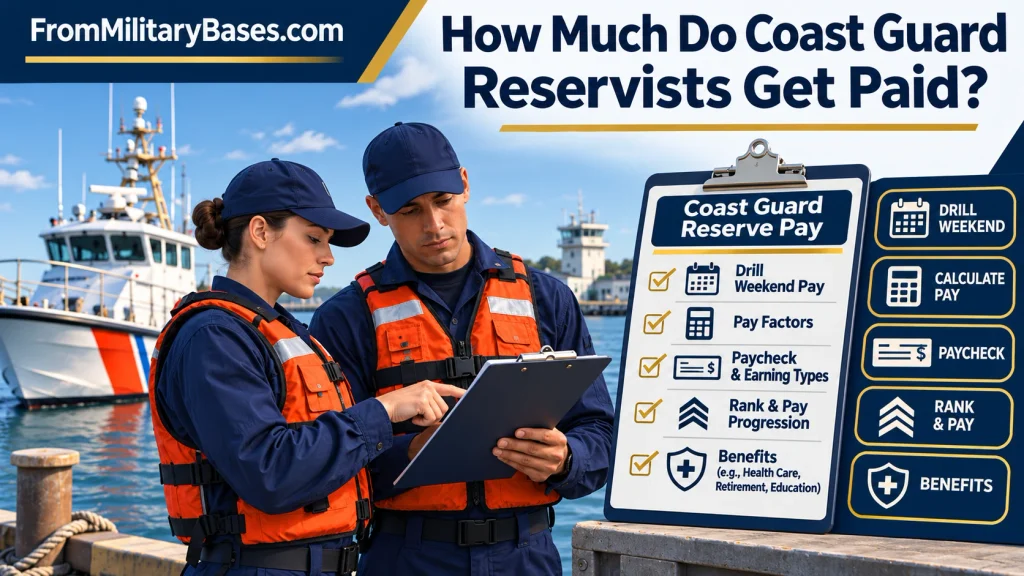
Reservists earn military basic pay for authorized paid duty. For inactive-duty drills, each paid period generally equals one-thirtieth of monthly active-duty basic pay at the member’s grade and creditable years of service.
Four paid drills therefore equal four days of basic pay, even when performed over two calendar days.
| Grade and service | One drill | Four drills |
|---|---|---|
| E-3, 2 years or less | $94.56 | $378.24 |
| E-4, 2 years or less | $104.74 | $418.96 |
Source: DFAS enlisted drill pay table. These examples are gross basic pay for four periods, not guaranteed monthly take-home pay. Taxes, insurance and other deductions can reduce the deposit.
During annual training or other active-duty orders, basic pay is generally calculated by days of active service, with allowances such as housing or subsistence determined by the particular orders and entitlement rules.
Ordinary drills do not automatically earn the full active-duty housing and food allowances.
For more pay grades, annual compensation examples and financial benefits, see my Coast Guard Reserve pay and benefits guide.
Coast Guard Reserve benefits
Benefits depend on membership category, duty status, length and character of service, and the program’s own eligibility rules. These are the major benefits to investigate.
| Benefit | What to verify |
|---|---|
| Health insurance | TRICARE Reserve Select is a premium-based plan for qualified SELRES members and eligible families. Activation, transitional coverage and federal employee health benefit eligibility affect enrollment. |
| Dental coverage | Eligible members and families may enroll in the applicable TRICARE dental program, with separate premium and duty-status rules. |
| Education | Montgomery GI Bill–Selected Reserve, qualifying Post-9/11 GI Bill service and Coast Guard tuition assistance under applicable annual policy. |
| Life insurance | Servicemembers’ Group Life Insurance for eligible members. |
| Commissary and exchange | Shopping privileges for eligible military members and dependents, subject to program rules. |
| Retirement | Retirement points, qualifying years and, where applicable, Blended Retirement System and Thrift Savings Plan benefits. |
Reserve membership does not automatically provide identical coverage to active-duty service. Check your eligibility before replacing civilian health insurance or relying on a benefit to cover tuition.
Can you attend college while serving in the Coast Guard Reserve?
Yes. College students can serve in the Reserve, and the RK enlisted program is designed for eligible applicants needing split training. You still need to meet military training requirements.
A-School, annual training or mobilization can conflict with classes, examinations, internships and graduation plans.
The Montgomery GI Bill–Selected Reserve (Chapter 1606) can provide up to 36 months of education benefits. Eligibility generally requires a six-year SELRES obligation, completion of initial active-duty training, the required secondary education credential and satisfactory participation.
Officers must agree to six additional years of SELRES service beyond their original obligation. Benefits generally end on leaving the SELRES, with exceptions.
The Post-9/11 GI Bill uses qualifying service rules; ordinary drill membership alone is not sufficient. Coast Guard tuition assistance is governed by current fiscal-year guidance and eligibility and funding conditions. Confirm what you qualify for with the education services office before budgeting around it.
Can Coast Guard Reservists be deployed?
Yes. Reservists may serve on domestic or overseas orders, voluntarily or involuntarily when authorized. Missions can involve disaster response, maritime security, defense readiness and operational support.
Not every Reservist deploys, and no recruiter can guarantee that a particular member will never be mobilized.
Routine inactive-duty training, annual training, voluntary active-duty orders and involuntary activation are different duty categories.
For example, 14 U.S.C. § 3713 provides an emergency augmentation authority with its own limits. Other statutory authorities can apply to different mobilizations, so those limits are not a universal deployment cap.
Ask about the unit’s mission, expected readiness requirements and potential extended duty. My Coast Guard deployment guide covers the broader service’s operations and deployment context.
Coast Guard Reserve pension and retirement
Reserve retirement is based on qualifying years and retirement points, not simply the number of years since enlistment. Under the usual non-regular retirement rules, you need at least 20 qualifying years.
A full anniversary year generally needs 50 retirement points to count as qualifying under 10 U.S.C. § 12732. Points can come from eligible drills, active service and qualifying membership.
Retired pay usually begins at age 60. Certain qualifying active-duty periods can reduce that age under statute, but generally not below age 50. A member with 20 qualifying years does not necessarily begin receiving retired pay immediately upon leaving the drilling Reserve.
Under the legacy retirement formula, applicable equivalent years of service are multiplied by 2.5% and the applicable retired-pay base. For the Blended Retirement System (BRS), the multiplier is 2% instead, alongside the system’s Thrift Savings Plan contribution and matching provisions.
Equivalent years for this purpose generally come from dividing creditable retirement points by 360. The pay base depends on the retirement system.
See 10 U.S.C. § 12731 for retirement eligibility and the Defense Department’s Reserve BRS guidance. Check your point record annually and resolve missing service entries before relying on a pension estimate.
Are Coast Guard Reservists considered veterans?
Not for every legal or benefits purpose simply because they joined or completed a Reserve contract. For many Department of Veterans Affairs programs, veteran status depends on qualifying active military service and discharge under conditions other than dishonorable.
38 U.S.C. § 101 also recognizes certain qualifying disabilities or deaths incurred during active duty for training and, for inactive-duty training, qualifying injuries or specified acute medical events.
Other statutes and benefit programs may use different eligibility rules. A Reservist can qualify for a particular benefit without qualifying for every VA benefit.
Can Coast Guard Reservists receive VA home loans?
Yes, eligible Reservists can qualify for a VA-backed home loan. Common pathways include at least 90 days of non-training active-duty service or six creditable years in the Selected Reserve with an applicable qualifying service status or discharge. A service-connected disability discharge may qualify under an exception.
For the six-year route, eligible circumstances include continued SELRES service, honorable discharge or placement on the retired list. Certain transfers after honorable service may also qualify under the VA Loan Guaranty guidance.
Check the VA home loan eligibility requirements for your service dates and status. You must obtain a Certificate of Eligibility (COE), and the lender still evaluates your finances and the property. Joining the Reserve does not immediately guarantee mortgage approval.
Can you buy back Coast Guard Reserve service?
If you are a federal civilian employee, you may be asking about a military service deposit under the Federal Employees Retirement System (FERS). Qualifying honorable active military service may count toward a civilian pension if you satisfy the applicable deposit and eligibility rules.
Ordinary inactive-duty drill periods generally are not creditable active military service for this purpose.
A military service deposit is separate from military Reserve retirement points. It is also different from redepositing previously withdrawn civilian retirement contributions.
Review OPM’s creditable-service rules with your agency’s retirement specialist, using your actual orders and service dates. Do not assume that buying civilian retirement credit changes your Reserve point total.
Can you switch from Coast Guard Reserve to active duty?
Yes, a permanent transition is possible, but it is not automatic. There are two different decisions:
- Temporary active duty: A Reservist may serve on authorized full-time orders while remaining a member of the Reserve.
- Permanent component change: An enlisted member or officer seeks accession or integration into the regular Coast Guard under an applicable program and approval process.
Enlisted applicants should discuss prior-service accession eligibility, available ratings, service obligations, release and grade determination with a recruiter and their personnel chain. Officers should distinguish extended active-duty (EAD) opportunities from permanent active-duty integration.
The Coast Guard’s explanation of officer integration describes that distinction; current board and personnel guidance controls individual applications.
If you already know you want a full-time military career, compare direct active-duty accession first. Joining the Reserve as a guaranteed shortcut into active duty is not a sound assumption.
Can you serve in the Coast Guard Reserve and Army Reserve?
Do not plan to drill simultaneously as an ordinary member of both components. The normal accession process for an applicant already serving in another component requires coordination and an approved conditional release where applicable, commonly using DD Form 368. A release request is not itself approval to transfer.
Disclose your current military affiliation and remaining obligation to both personnel authorities. If you have an unusual statutory status or appointment, ask them to determine whether a specific exception applies. Do not sign a second enlistment on the assumption that the first obligation disappears.
Air National Guard vs. Coast Guard Reserve
Both can provide part-time military careers, federal military pay and eligible benefits. The right choice depends on the mission, local vacancies and training opportunities you can actually access.
| Coast Guard Reserve | Air National Guard |
|---|---|
| Federal maritime service: port security, maritime response and operational support. | Air Force component with state or territorial and federal responsibilities; aviation and air base missions. |
| Maritime, engineering, logistics, security and professional assignments. | Aircraft maintenance, air operations, cyber, security, logistics and other available specialties. |
| Assignment depends on Coast Guard unit and billet availability. | Assignment depends on available positions at Guard wings and units. |
| Drills, annual training, additional readiness duties and possible federal mobilization. | Drills, annual training and possible federal activation or state missions. |
| Federal military pay and benefits under applicable status and eligibility rules. | Comparable federal basic pay for equivalent grade, service and duty; state benefits and state-duty compensation can differ. |
| Federal education benefits and applicable Coast Guard tuition assistance. | Federal education benefits plus potentially state-specific education programs. |
| Non-regular military retirement rules. | Non-regular military retirement rules. |
See the Air National Guard recruiting overview and ask the relevant state or territorial unit about its benefits. I would compare written offers, travel distance and school dates before deciding. Aviation interest alone does not guarantee a flying position in either component.
When is the Coast Guard Reserve birthday?
The Coast Guard Reserve celebrates its birthday on February 19, 1941, when legislation established the military Reserve and redesignated the earlier civilian volunteer organization as the Auxiliary.
The Coast Guard traces its own founding to August 4, 1790. These are distinct anniversaries. See the official Reserve history and mission overview.
Is the Coast Guard Reserve worth it?
It can be a good fit if you want military service without immediately leaving a civilian career, have an appropriate billet within reasonable traveling distance and can handle the initial training and potential mobilization.
It is less attractive if you need a predictable extra income with no extended absence, or if your desired job is unavailable locally.
| Potential advantages | Potential disadvantages |
|---|---|
| Part-time military service alongside civilian work or college. | Training and activation may interrupt those commitments. |
| Pay for authorized duty and access to qualifying benefits. | Drill income alone is limited; benefit eligibility varies. |
| Maritime skills, leadership and professional development. | Limited local billets and qualification requirements can restrict job choice. |
| Opportunity to build retirement eligibility over a long career. | Retirement requires qualifying years; payments are usually deferred. |
Should you join the Coast Guard Reserve?
Before deciding, ask the recruiter these questions and request written confirmation where appropriate:
- Which accession program do I qualify for, including any waivers?
- Which rating, grade, billet and unit can I actually obtain?
- How long will initial training and specialty school take, and when can I attend?
- How many years must I serve in the SELRES, and what obligation remains afterward?
- What is the unit’s normal training schedule, travel policy and mobilization expectation?
- Which healthcare, education, insurance and incentive programs would I qualify for?
- If my civilian plans change, what approvals would I need to relocate, change ratings or seek active-duty service?
If the answers fit your civilian plans and military goals, the Reserve may offer a useful combination of both. If you primarily want a full-time military job, compare active-duty entry. If you want a nearby aviation-oriented career, investigate the Air National Guard. If you want civilian maritime volunteering rather than military obligations, consider the Auxiliary.
The most useful comparison is between real positions and real commitments, not between recruiting slogans. Start with the official Coast Guard Reserve recruiting office resources and make your decision using the requirements and assignment you can actually obtain.

Jeffrey Rogers has served in the United States Army for 18 years. Jeffrey served on overseas combat tours in Afghanistan and Iraq. Jeffrey Rogers was born in Norfolk, Virginia. He graduated in Information technology from George Mason University. Now, Jeffrey is the content head of Frommilitarybases.com.