
A Coast Guard rescue swimmer is a specially trained enlisted aviation professional who can deploy from a helicopter to assist people in danger at sea or on land. The Coast Guard’s enlisted career specialty is Aviation Survival Technician (AST). Rescue swimmer is an operational role and qualification associated with ASTs—not a separate enlisted rating or a job awarded simply for joining the service.
To pursue it, you must qualify to enlist, enter an eligible AST training pathway, pass demanding medical and physical screening, complete AST school, and then earn operational qualifications at your assigned aviation unit.
ASTs also maintain lifesaving equipment and support aircrew survival training between missions. The Coast Guard’s official AST recruiting description is the starting authority for the occupation. For a comparison with other specialties, see FMB’s guide to Coast Guard jobs and ratings.
Coast Guard rescue swimmer at a glance
| Question | What applicants need to know |
|---|---|
| Official enlisted rating | Aviation Survival Technician (AST); helicopter rescue swimmer is a specialized operational duty and qualification. |
| Main work | Rescue support, emergency medical assistance, aviation life-support equipment inspection and maintenance, and survival training. |
| Current school location | Training Center Petaluma, California, according to the Coast Guard’s current AST school listing; Elizabeth City, North Carolina, was the historical school location. |
| Published rating course | 22 weeks on the current Coast Guard recruiting and Petaluma training pages; additional on-unit qualification follows graduation. |
| Pay | Regular military basic pay by pay grade and years of service, plus allowances and special pays when individually authorized. |
| Typical assignment type | Coast Guard air stations and aviation units; an exact location or helicopter position is not guaranteed. |
What does a Coast Guard rescue swimmer do?
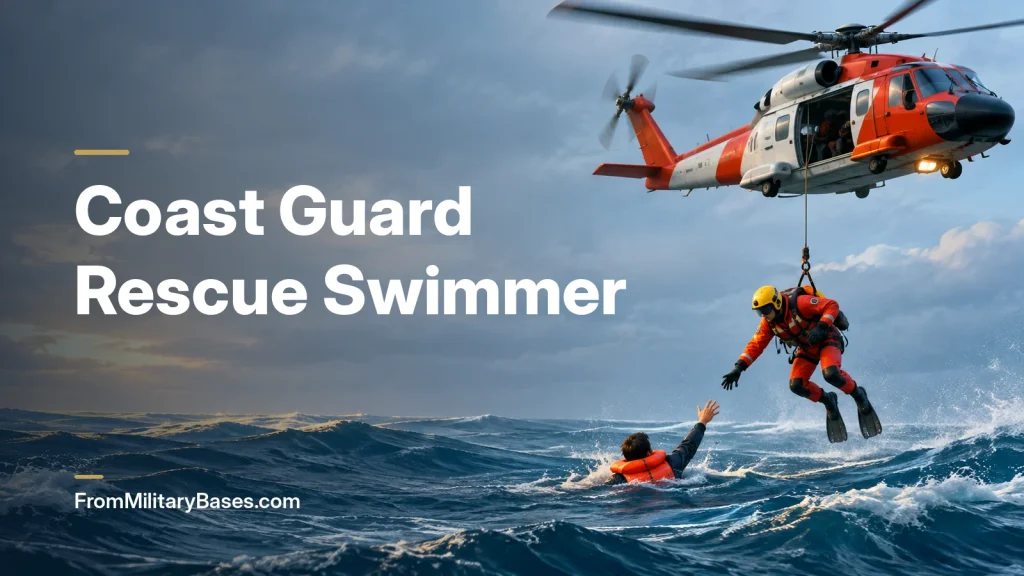
On a helicopter rescue, the swimmer is one member of a coordinated aircrew. Pilots fly the aircraft, another crew member may operate the hoist, and the swimmer may enter the water or another rescue environment to reach and prepare a survivor for recovery.
The crew evaluates the conditions, available equipment and risks before a deployment. A 2025 Coast Guard search-and-rescue addendum, section 5.8, explains conditional helicopter-swimmer deployment and distinguishes helicopter rescue swimmers from surface swimmers. It is historical context: a February 2026 Coast Guard policy message announced an updated addendum and competency guidance, so operational personnel must consult the currently applicable manuals.
The mission can involve a person in rough water, a medical evacuation from a vessel, a flood rescue inland or assistance in difficult coastal terrain.
A May 2025 Coast Guard release describes an Astoria helicopter crew deploying two swimmers into a damaged water tower to help evacuate injured workers—an example of why the job is not limited to the ocean.
But a rescue call is only one part of the rating. ASTs inspect, service and repair aviation survival equipment and rescue devices, manage safety-related records, help deliver water- and aircrew-survival instruction, practice emergency medical and rescue procedures, and maintain qualifications.
The Coast Guard’s Aviation Technical Training Center occupation description describes this technical workload. Someone who wants only action-oriented rescues, without detailed equipment responsibility, is misunderstanding the profession.
AST versus pilot, mechanic and surface swimmer
| Role | Core distinction |
|---|---|
| AST | Enlisted aviation survival-equipment specialist; qualified members can serve as helicopter rescue swimmers. |
| Coast Guard pilot | Commissioned officer who flies the aircraft; not the AST rating. See FMB’s Coast Guard pilot career guide. |
| Aviation Maintenance Technician (AMT) or Avionics Electrical Technician (AET) | Other enlisted aviation ratings with their own maintenance and aircrew responsibilities; these ratings do not automatically confer the AST rescue-swimmer qualification. |
| Cutter or boat-unit surface swimmer | A separate collateral-duty capability with different qualification and deployment rules, as described in the Coast Guard search-and-rescue supplement. |
AST is also not synonymous with a special-operations unit. If you are comparing service branches, FMB’s Coast Guard versus Navy guide covers the broader institutional distinctions.
How do you become a Coast Guard rescue swimmer?
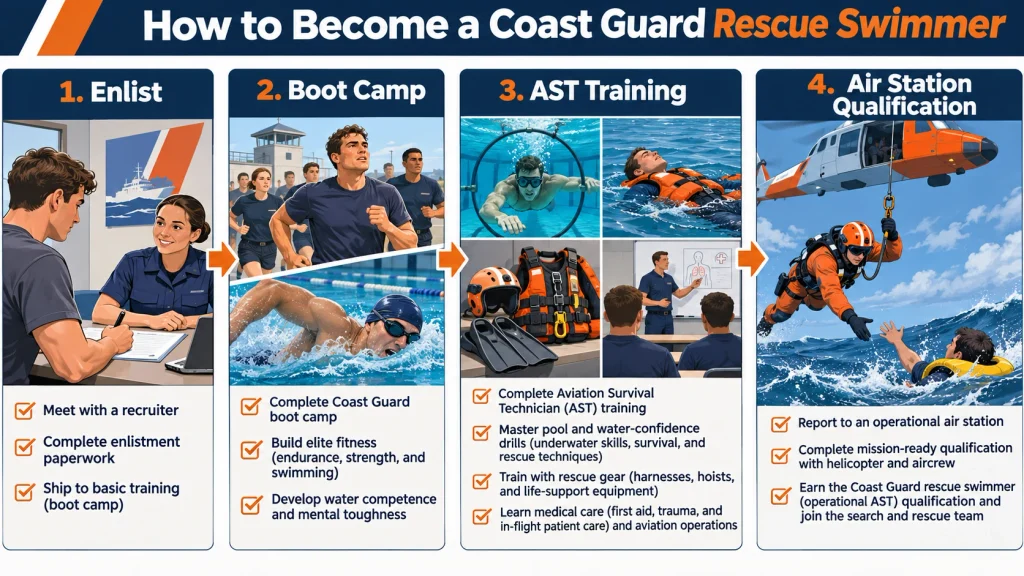
- Confirm basic enlistment eligibility. Review age, citizenship or eligible immigration status, education, conduct, dependents, medical history and fitness with a Coast Guard recruiter.
FMB’s general Coast Guard enlistment guide explains the service-wide process; verify its older numeric requirements against the current official policy. The service raised its general maximum enlistment age to 42 in a 2022 recruiting policy announcement, but an AST applicant must meet the current requirements for that rating and any program-specific limits.
A 17-year-old applicant needs parental consent. Do not rely on older FMB articles quoting a general age ceiling of 31. - Contact a recruiter and take the qualifying tests. The Coast Guard’s current getting-started guidance identifies the ASVAB, the Military Entrance Processing Station (MEPS) medical and drug screening, and background checks.
It publishes a general AFQT enlistment minimum of 32; AST’s applicable occupational aptitude criteria and clearance eligibility must be checked separately. The AST training center notes an aircrew-candidate physical and eligibility for a Secret clearance. - Review what any enlistment contract actually offers. Joining the Coast Guard is not the same as securing an AST school seat. Ask whether a specific program offers guaranteed specialty training, which prerequisites remain, whether a waiting list applies, and what happens if you fail screening or training.
The official enlisted accession page distinguishes full-time and Reserve application routes. - Complete recruit training or the accession training specified for your program. The standard enlisted boot camp takes place at Training Center Cape May, New Jersey.
See FMB’s Coast Guard boot camp guide for the broader recruit-training topic; the AST-specific process continues after basic training. - Seek AST A-school placement and complete any required preparation. The Coast Guard has historically used an AST school applicant list, screening and an AST preparatory course.
Its Petaluma training listing currently identifies a five-day AST PREP course. Eligibility, course sequencing and school dates are controlled by the current personnel and training authorities—not a promise made by a general careers article. - Pass AST A-school. The published 22-week course combines emergency medical, helicopter rescue-swimmer and aviation life-support equipment instruction. Tests involve skill, endurance, water confidence and technical work; being a good pool swimmer alone is insufficient.
- Qualify with your operational aviation unit. Graduation does not by itself mean you are immediately designated to every helicopter rescue-swimmer duty.
Coast Guard reporting on the first Petaluma graduates in 2022 says graduates proceed to aviation units for additional qualification. Operational crew and aircraft proficiency, training records and local certification matter. - Maintain qualifications throughout the career. Operational readiness depends on continued physical assessments, medical and emergency-care proficiency, equipment competency, regular crew drills and qualification currency.
I would ask a recruiter four questions before making an AST-focused enlistment decision: What makes me eligible for AST school now? What is the current AST fitness screening document? Which parts of the school and first assignment are written into my contract? What is the process if a medical or training issue prevents qualification?
Physical fitness and swimming requirements: which test applies?
There are several distinct checkpoints: general Coast Guard accession fitness, AST school candidate screening, and recurring operational rescue-swimmer assessments.
Numbers for one should never be sold as the minimum for all three. The Coast Guard established a broader service-wide physical readiness program in ALCOAST 007/26 (January 2026), which also acknowledges separate fitness requirements for specialties such as ASTs.
| Test or event | Verified published information | Stage and limitation |
|---|---|---|
| 1.5-mile run | Coast Guard recruiting page: 12:29 male / 15:05 female. | General recruiting fitness expectations as displayed on its eligibility page; not an AST entry cutoff. |
| Push-ups | 29 male / 15 female in one minute on the recruiting page. | General published recruiting expectations; AST screening is separate. |
| Forearm plank | 1:18 male / 1:09 female on the recruiting page. | General recruiting expectations. Do not substitute old sit-up tables for these values. |
| Swimming and water confidence | Coast Guard recruiting confirms swim training in boot camp and OCS; the AST specialty requires exceptional water confidence. | A current, public 2026 AST applicant cutoff could not be independently established from the current AST school page. |
| Pull-ups, chin-ups, sit-ups, underwater swimming and buddy towing | Various older AST messages and third-party guides publish figures, but they are not verified here as current 2026 AST admission cutoffs. | Ask the recruiter or AST school for the current Physical Training Screen Exam (PTSE) and operational assessment documentation; never improvise underwater testing alone. |
| Recurring operational fitness | Separate qualification and readiness policies govern designated helicopter rescue swimmers. | Not interchangeable with the general accession test; obtain the current applicable rescue-swimmer manual and unit guidance. |
Source for the general figures: Coast Guard eligibility and fitness requirements. For historical context only, ALCGENL 157/19 (August 2019) stated a 450-meter swim under 12 minutes, four underwater laps, 40 push-ups, 50 sit-ups, three pull-ups, three chin-ups and a 1.5-mile run under 12 minutes for that period’s AST applicants.
Those figures are not presented as the operative 2026 standard. A 2026 applicant should request the currently issued test and authorized administration procedures.
Successful preparation requires aerobic fitness, strength, technique, recovery and controlled water confidence. Underwater breath-holding drills and buddy tows carry real drowning risk; practice them only within supervised instruction using approved safety procedures, never alone.
Where is Coast Guard rescue swimmer A-school?
The currently published Coast Guard AST A-school listing identifies Training Center Petaluma, California. The Petaluma training directory lists AST course 501072, a 22-week program and the preparatory course.
A 2026 congressional oversight record also describes AST training continuing at Petaluma while the Elizabeth City pool is renovated. This is stronger present-location evidence than an older page whose school description has not been updated.
Why the conflicting Elizabeth City references? For decades, ASTs trained at the Aviation Technical Training Center (ATTC) in Elizabeth City, North Carolina.
In 2022, pool damage and the need for facility repairs led the Coast Guard to move the school temporarily to Petaluma.
A Coast Guard release from August 2022 reports the initial Petaluma class and says some rescue-swimmer skills instruction also occurred at Norfolk, Virginia, during that initial arrangement. That is not evidence every current class travels to Norfolk.
Two live Coast Guard pages also describe the course differently. The recruiting page gives 22 weeks divided into seven weeks of EMT, 10 weeks of rescue swimming and five weeks of life-support training.
The Petaluma school listing gives the same 22-week course with a six-week EMT phase, 10-week rescue phase and five-week AST phase. Those phase figures add up to 21 weeks rather than 22 and may omit transitions or administration; neither page explains the difference.
The older ATTC page still refers to a four-month initial course and treats EMT as advanced training. I would use 22 weeks as the currently advertised overall course length and confirm the exact upcoming schedule directly with the school.
How difficult is the training?
AST candidates must perform under fatigue, in and around water, while learning rescue techniques, medical skills and equipment procedures. Their training combines physical endurance, controlled emergency-response problem solving, aircrew coordination and detailed technical assessment.
A medically qualified applicant can still fail a required performance assessment or find that the occupational environment is unsuitable.
The Coast Guard’s 2022 first-class report discusses a particularly successful initial Petaluma class, but its results are a snapshot, not a current service-wide completion or washout rate.
The recruiting page emphasizes the demanding course and ongoing advanced opportunities. I would not use unattributed internet claims about 50%, 80% or any other fixed failure rate as a planning assumption.
After graduation, rescue swimmers can undertake additional operational and heavy-weather training. A May 2026 Coast Guard account documents advanced helicopter rescue training in Astoria, Oregon. This is advanced training, not a replacement for AST A-school in Petaluma.
How much does a Coast Guard rescue swimmer make?
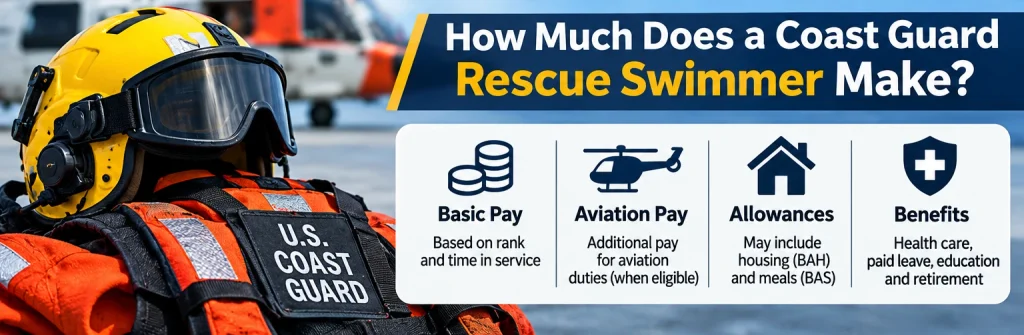
There is no single official salary for the job. An AST receives basic military pay based on enlisted pay grade and creditable years of service. Location, housing eligibility, subsistence, duty status, authorized specialty payments, bonuses and deductions change total compensation.
Neither graduating from AST school nor performing one rescue automatically sets a unique salary.
2026 basic pay examples
These are illustrative combinations, not promises of rank progression, drawn from the DFAS enlisted basic-pay table effective January 1, 2026. Annual figures equal the official monthly figure multiplied by 12; they exclude housing, subsistence, incentives, tax and deductions.
| Illustrative pay grade and service | Monthly basic pay | Annual basic pay |
|---|---|---|
| E-3, two years or less | $2,836.80 | $34,041.60 |
| E-4, over four years | $3,658.50 | $43,902.00 |
| E-5, over six years | $4,110.00 | $49,320.00 |
| E-6, over eight years | $4,612.80 | $55,353.60 |
What could allowances add?
For 2026, the DFAS standard enlisted Basic Allowance for Subsistence (BAS) table shows $476.95 per month. As an illustration, an otherwise eligible E-4 in the over-four-years column would have $3,658.50 basic pay + $476.95 BAS = $4,135.45 per month, or $49,625.40 over 12 months, before any separately applicable housing allowance or special pay.
BAS entitlement, meal deductions and actual circumstances must be checked individually; this is not take-home pay.
Basic Allowance for Housing (BAH) varies with duty location, dependent status and eligibility; some members use government-provided quarters instead. Rescue-swimmer-specific special duty pay and aviation-related incentive or hazardous-duty entitlements are governed by separate orders and qualification rules.
Historical Coast Guard special-pay announcements recognize designated operational rescue swimmers, but a past award rule is not proof of a particular 2026 payment.
Request the current pay authority and your duty-position eligibility before adding any incentive to a budget. Likewise, a general recruiting bonus advertisement does not establish that an AST applicant is eligible.
Military pay can also come with qualifying healthcare, leave, tuition assistance, GI Bill benefits, Thrift Savings Plan participation and retirement provisions. These have different service and eligibility rules.
The Coast Guard benefits overview is a useful general reference; gross military compensation and a bank deposit are not equivalent.
Where do Coast Guard rescue swimmers work?
ASTs are typically assigned to air stations and aviation units. Assignment may involve a unit operating helicopters, an aviation support role, training or staff responsibilities.
Being assigned to an aviation facility does not, by itself, establish that every AST serves as a qualified rescue swimmer on every flight.
For geographic examples, official Coast Guard releases document an Air Station Astoria helicopter rescue operation in Oregon and an Air Station Corpus Christi rescue in Texas. The Coast Guard historical office identifies Air Station Cape Cod in Massachusetts as an air station still in service. These are examples, not a list of vacancies or guaranteed assignments.
An air station is not the same administrative entity as a sector, boat station, training center or Coast Guard base. To explore the geography separately, see FMB’s Coast Guard air stations guide and Coast Guard installations directory.
Verify each current unit directly before making relocation decisions; an online directory is not a live personnel-assignment roster.
What is everyday life like?
Most of the job is readiness work rather than a continuous series of rescues. Depending on billet and qualification, an AST can spend time inspecting life-saving equipment, updating maintenance records, conducting crew water-survival instruction, performing physical training, exercising hoist and patient-recovery procedures, studying medical protocols and standing operational duty.
Calls can interrupt planned work. Missions and training may take place in cold water, heat, storms, low visibility, moving seas and difficult terrain.
Air-station duty rosters, standby schedules, deployments and temporary assignments depend on unit mission and staffing. No Coast Guard-wide public source reviewed here establishes a universal AST workday, number of rescue missions per month, or predictable nights-at-home guarantee.
The broader Coast Guard lifestyle tradeoffs may help with the service-level decision, but the actual AST duty billet is the controlling variable.
Career progression and civilian opportunities
ASTs can advance through enlisted petty-officer grades under Coast Guard promotion requirements. Depending on vacancies, performance and qualifications, experienced ASTs may serve in senior technical, instructor, shop leadership, training-standardization or other aviation-survival responsibilities.
Advanced helicopter-rescue and survival-instructor courses may be available; nothing in a job description guarantees a place in any particular school or promotion.
Transferable capabilities include emergency medical assessment, equipment inspection, safety training, procedure compliance, team communication and rescue operations.
The Coast Guard specifically lists EMT, parachute-rigging and repair, survival instruction and commercial life-support equipment work as related civilian fields.
An actual civilian EMT, paramedic, aircraft-maintenance or safety job may require its own state license, employer training or civilian credential. Military experience does not automatically issue those credentials or guarantee employment.
Can you be an AST in the Coast Guard Reserve? What about officers?
The Coast Guard’s enlisted careers directory labels AST as an active-duty and Reserve rating. However, an available Reserve AST rating pathway is not proof of a currently open helicopter-rescue-swimmer billet in any particular city. Official Reserve recruiting guidance ties entry and training to specialty, accession program and available assignments.
If part-time service is the objective, ask the Reserve recruiter for an actual AST vacancy, required prior experience and whether the billet includes operational rescue-swimmer duties. FMB’s Reserve pay and benefits guide explains why drill pay differs from full-time compensation.
AST is an enlisted rating. A commissioned Coast Guard aviator flies or commands aircraft as an officer through a different training and career system. Joining as an officer is not the standard AST rescue-swimmer accession path.
The Coast Guard is a military service even though it ordinarily operates within Homeland Security; see FMB’s legal overview of Coast Guard military status if that distinction affects your decision.
Risks and realistic expectations
A helicopter rescue can expose crews to rotor wash, severe weather, unstable survivors, difficult hoists, surf, debris and fatigue.
Medical and mechanical errors can also have serious consequences. Risk management, rehearsal, qualification limits and crew coordination are essential safeguards; they do not eliminate danger.
The reality is documented, not hypothetical: the Coast Guard announced in March 2026 that Aviation Survival Technician Tyler Jaggers died following injuries during an offshore rescue operation.
That specific loss should not be extrapolated into an unsupported injury or fatality rate. A strong applicant should take both physical screening and the less-visible equipment and medical responsibilities seriously.
Notable rescue swimmers: is there a “most decorated”?
I could not verify an authoritative Coast Guard-wide ranking that identifies one person as the most decorated Coast Guard rescue swimmer. Award categories, career lengths and definitions of “decorated” differ. I would not assign that title on the basis of a search snippet or a collection of individual honors.
One documented example is Scott Ruskan, a Coast Guard AST recognized for his role in the July 2025 Central Texas flood response. A July 29, 2026 Coast Guard account records his Pat Tillman Award for Service at the 2026 ESPYS.
That honor is not an official Coast Guard ranking of all rescue-swimmer decorations. Public reports also describe other military honors; the precise award citation should govern any account of a specific decoration.
Practical decision checklist
- Decide whether you want the full AST technical job, including equipment maintenance and crew instruction, rather than rescue scenes alone.
- Review the current Coast Guard accession requirements and disclose medical and eligibility questions to a recruiter.
- Get the current AST-specific fitness screen and school eligibility criteria from the official recruiting and school chain. Do not train to an old third-party cutoff.
- Ask what your contract guarantees, if anything, concerning AST school, the class date and the active-duty or Reserve path.
- Understand that the published 22-week school is only one milestone; unit-level aircraft and rescue-swimmer qualifications follow.
- Build a compensation estimate from your actual projected grade, years of service and assignment—not a fictional standard rescue-swimmer salary.
Bottom line: The Coast Guard rescue-swimmer career is an enlisted AST pathway combining technically demanding survival-equipment work, emergency medical training and high-stakes rescue operations. The most important distinction is between qualifying to join, being selected for AST school, graduating and earning operational rescue-swimmer qualifications. Verify each stage independently before committing.

Jeffrey Rogers has served in the United States Army for 18 years. Jeffrey served on overseas combat tours in Afghanistan and Iraq. Jeffrey Rogers was born in Norfolk, Virginia. He graduated in Information technology from George Mason University. Now, Jeffrey is the content head of Frommilitarybases.com.
1 thought on “Coast Guard Rescue Swimmer: Requirements, Training & Pay”